
Showing posts with label hexcrawl. Show all posts
Showing posts with label hexcrawl. Show all posts
30 July 2024

21 April 2023
Nearheath and Mornsong Wood
Here are two more-representative hexes. Each has an adventure and a wonder.


20 April 2023
Hex 0500 - Cradle Wood

Here is a sample page from the hex crawl booklet I am building for the Westmarch campaign. The upper left quadrant has the name and terain type. N = 3 means that we check for encounters three times on 1d6 when traveling across the hex; we check encounters once per hour, with 1-3 on 1d10 meaning an encounter occurs while exploring in the hex.
The wandering monster table has only four monster entries. This is because 1) there really won't be that many chances to roll on the table, which obviates the need for variety and 2) to enforce the idea that "this hex contains X" for any given hex.
When a monster entry comes up (or in some cases, the Faction entry I suppose) we roll on Table 1 as well to see what kind of encounter it will be.

The Faction entry shows who controls the hex, or in the case of a wild hex, the most likely named NPC or faction the party will encounter. This hex is adjacent to the fort ruled by Lord Atlan, so it is most likely you would meet his men or even himself (and I would shade toward the latter, because it's cool to meet named NPCs.)
The Special tells us that there is some feature in the hex; a town, village, landmark of note or wondrous locale.
 |
Cities are placed and marked on my map. Any time we roll a wonder for the second time in a hex, it is a landmark instead.

Her is my landmark generator. It is overly complex; I'm not sure what to do about it except just make stuff up at the play table. Maybe I should use it to generate some landmarks beforehand so I have a list? Here is a stable link to the .pdf.
14 April 2023
Westmarch Crawl Format
I've been going through all my 6-mile hexes and assigning each a wandering monster table, an adventure and a wonder. The one-mile hexes are numbered 1-30 so we can randomly determine where in the hex various features reside - just in case it's important later, which it might be.
Each hex (Except for the castle hex) ought to be an adventure site of its own, and many of them will be suitable to return to over and over.
As the several players explore and level up, I will suggest to them that their characters ought to fortify areas out in the world as staging areas. There will be towns and villages; some will be adventure sites in their own right and some will be neutral or friendly. By fortifying these areas, the characters will be able to travel farther as well as tame the land. If they have to return to 0800 every day, they won't be able to go much farther than the first adjacent hex.
This will also prepare the people for their new lords, who will (hopefully?) be PCs.
Here are the charts we use to determine 1) what the encounter is about and 2) what the Special will be. You can see that the Special gets hoarier as the land gets wilder.


(Recall that overland travel requires N checks per hex on 1d6, checked upon hex entry; exploring a hex requires one check per hour, with 1-N on 1d10 resulting in an encounter.)
This particular hex has no adventure in it. I don't want the players stopping here - this is safe home territory.
Question for the penny groundlings: shall we give the several characters a chance to get lost, or shall we forego that part of the crawl? It seems punitive to me tbh.
10 April 2023
Different Hexes Taste Different
In the Westmarch sandbox, I've decided each hex will have a short encounter table with only four monsters plus a Faction entry (based on nearby power centers) and a Special entry (based on the terrain, population, and unique features.)

At the start, I'll only be building
- 12 or so of these little encounter tables,
- plus the subtables we talked about yesterday (largely unedited from that post),
- plus a Behavior table to help me flesh out the encounter.
Why only four monsters on the encounter table? I want to be able to make a strong theme for each hex and then beat the players over the head with it, so that they are immediately aware of "oh, we're in a new area."
The Scrybwood is going to be strongly faerie-flavored. The Durkwood will be strongly pig-flavored. The Ironwood will be dense with ents and ent clues. The Forest of Regrets will be filled with elfs and their allies.
etc.
If I have only four entries, I can make one be the main creature type, one be a subsidiary of it (dire boar and wereboar for instance,) have one boss-fight type (wyvern, stone giant, bandit army) and one undead or lycan type. This way, hex taste will be reinforced with many of the encounters.
When the character of the hex changes, I will substitute one or more of the listings. When the party kills the green dragon in hex 0204, I'll replace it with a family of hippogriffs or an army of orcs or something.
Each entry will have the (number appearing) of (creature name) and (lair %.) Probably something I would be willing to fudge for the purposes of verisimilitude, but not to "fix" it for the players.
So here's that Behaviors table:

So with this table, I can roll the entity encountered, what that entity is doing, and what problem it might have. These will just be suggestions, but suggestions that will prevent the "Orc-And-Pie" problem popping up with every encounter.
09 April 2023
Special Nested Encounter Tables
In the Westmarch sandbox I’m building, each hex will have a unique, very short encounter table. There will be four listings for monsters, plus a Faction, plus a Special. That makes for a 1d6 table.


A Message For You, Rudy
I think the Specials should be hex features: some landmarks, some wondrous locales, and some towns and villages. That means there have to be different charts for more-civilized and less-civilized regions.
I already use three levels of civilization for my domain rules so I’ll use the same ones here: civilized, borderlands and wilderlands. So I will have three subtables for the Special result, SC, SB and SW or S1, S2 and S3 (haven’t decided yet.) The correct subtable will be indicated on the appropriate main table.
Nested Special tables
Table SC Civilized
1 town
2 village
3 village
4 landmark
(Cities are always placed)
Table SB Borderlands
1 village
2 village
3 landmark
4 landmark
5 wandering merchant
6 wonder
Table SW Wilderlands
1 homestead
2 fort (landmark)
3 demihuman village
4 wonder
5 wonder
6 landmark
In any individual hex, there is a maximum of one wonder to discover. Once that hex’s wonder is discovered, that listing becomes a landmark instead.
08 April 2023
Time, Place and Action

Bryce at Ten Foot Pole makes an excellent point today about how each hex in a hexcrawl needs a situation. It’s not just (place + time); there has to be action as well.
He got this across to me in a fun way: hexes are mini-adventures. Or, another way to think about it is that each hex is an episode of an ongoing TV series.
So far on my hex map, I have defined each each hex with:
1) an evocative name
2) its own (short) random encounter table
3) possible factions, based on nearby power centers (and a chance per the table for one of them to pop up to make mischief of one kind or another)
Now I will add:
4) a short OSR challenge that will pop up, if the several players decide to stop traveling and start exploring.
Bammo! Instant episode. Possibly good for a single session, depending. But even if it’s solved fast, there is a lot more going on in each hex.
06 April 2023
Wilderness Overland Travel versus Wilderness Exploration
This is probably stupid and obvious to you but it's just become crystalized in my mind: Travel is not the same as exploration and therefore requires different procedures.
This hot nugget hit me over the head with a steel chair when I was making up the Ref panel for my hexcrawl campaign. I made this chart, and I like it:

The last two columns are for rolling for encounters. I'm going to try it like this.
If the party are moving overland, then they have N checks on a 1d6 every time they enter a hex. Any result of '1' results in an encounter. That encounter triggers 1d8-1 hours after they enter a hex, but always while they are in that hex.
If the party have stopped in a hex to explore, they have an N in 10 chance to have an encounter every hour. I think this is better because it will speed things along a little.
Again, traveling:
- throw 1d6 N times upon entering a new hex.
- a 1 result generates an encounter.
- each of the encounters will happen 1d8-1 hours after they enter, but always before they enter the next one.
Again, exploring:
- throw a 1d10 each hour.
- a result of N or less generates an encounter during that hour.
Also note that I am using movement points per hex instead of miles per day, and N hews closely (but not perfectly) to the number of movement points necessary to cross. This makes more costly hexes to travel potentially more dangerous too, which I think is the way it should be.
What do you think?
05 April 2023
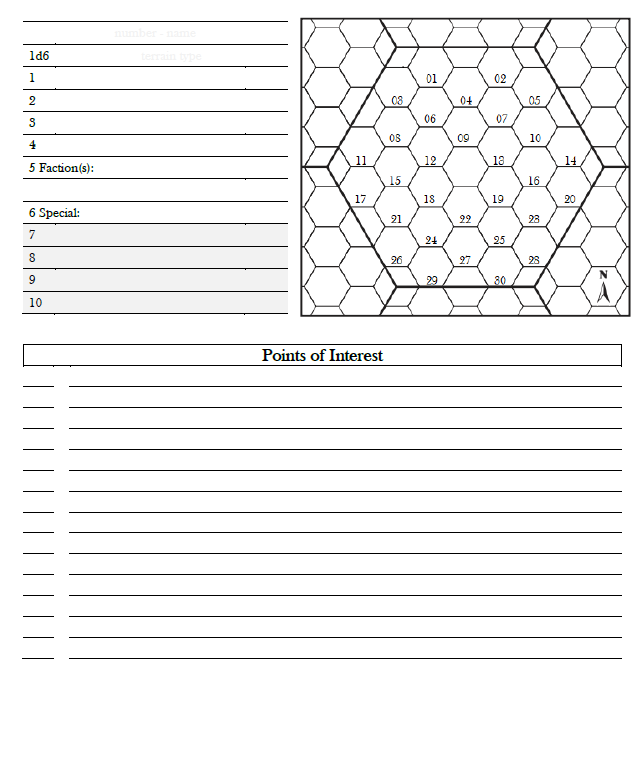
Hexcrawl Single-Hex Worksheet
04 April 2023
Octagon Crawl
PROTIP: Weird headlines draw eyeballs.
I’m working on my Westmarch campaign sandbox now, building simple and flavorful generative content for each hex. Of course much of that is from the random tables.
My random encounter tables will have four listings for monster encounters, one marked FACTION, and one marked SPECIAL. These each lead to other subtables.

FACTION will give me a chance to bring names NPCs into the picture to give the players a feel about the geopolitics, give quest hooks, and maybe make friends or enemies. I will almost always know which faction(s) are in the region.
SPECIAL is a landmark (wonder or natural feature), a settlement, or a merchant.
The idea is that the first 2/3 of the table gives hyper-local flavor and the last 1/3 is broader details of the world and logistical support.
On its own this suggests a heck of a lot of wandering tables, but I don’t need to make them all up ahead of time. The several players are only going to chew through a few hexes a night in any particular direction and I suspect there will be a lot of times when they stay in one hex. Furthermore, each only has four entries (with four auxiliary entries to use if the first ones don’t make sense.) it’ll be more formatting hassle than anything.
27 March 2023
Elevator Pitch for the The Ongoing Cyfandil Campaign
The handbill on the wall of the Brass Dragon reads,

06 March 2023
Food, Water, Air

Outdoor survival is theoretically a cornerstone to overland travel, although rules about it are scant. I don’t feel like diving into the DSG (shame on me) so I’ve written my own rules on starvation.
This stuff shouldn’t come up a heck of a lot but it will be critical to have such rules when it does come up. The last thing I want is to waive off rationing on one hand, or arbitrarily killing a figure on the other.
In terms of long-term starvation, characters need food in three weeks, water in three days and air in three minutes.
At the end of one period without food or water, they lose 1/3 of their healthy hit point total and can no longer heal. Then at the end of the second period, they lose another 1/3. Finally at the end of the third such period, they are at 1 hit point and must save or die every day. It takes as long to heal back as the starvation lasts.
Suffocation requires a Save vs death after three minutes and every minute thereafter.
22 December 2022
Overland Movement Points
Fresh and fully-supplied men, in new chariots, pulled by fresh horses, along good Roman roads, in good weather, with no potential for banditry or dragon attacks, could travel 24 miles in a day, and 30 if they hustle.

Therefore, medieval fantasy gamers have long presumed a 24-mile travel day overland.
On a long sojourn, with horses who need to graze and men who need to forage, carrying armor and gear, through dreadful unknown country, under changeable skies, in fear of unknown monsters around every dog leg, possibly transporting wounded men, and setting camp each night catch-as-catch-can, that 24-mile assumption looks like, well, a fantasy.
You can see where I’m going with this.
My assumption for overland travel speed is 12 miles a day, and even that is pushing it a little. Twelve miles of walking and climbing through unknown wilderlands with a moderate burden would be a challenge for most folks, even those who are prepared for the task.
Twelve miles is a good round number though, because we measure off wilderlands in six-mile hexes. (Remember that means center-to-center or edge-to-edge is six miles, center-to-edge is three miles and center-to-vertex is 3.5 miles.)
So we will say that through light forest and over farmland and the like, a party will move about twelve miles a day or 18 on a really good day. But through dense forest, through swamps, over a mountain, or through bare desert, it will be impossible to make any more than 12 miles in a day under most conditions.
How shall we model this?
Like the rest of the rules in Crown & Valor, I sought a compromise between precision, speed and ease. The solution I found was to forget miles (sorta) and assign movement points. Here is how it works:
The party gets three movement points per day. Entering a new hex costs some number of those movement points. Easy terrain costs one point, while harder terrains cost more. That means a day on good roads will net three hexes, or about 16-20 miles.
Furthermore, if the party uses zero, one or two points on one day, they carry one extra point over to the next day, for a maximum of four movement points. They can’t save up more than four at a time.
The next task is to assign each kind of terrain the cost of 1, 2 or 3 movement points. It’s easy to eyeball which gets which.
These numbers are just for overland movement on foot. Traveling by water or, as adventurous men sometimes do, through the thin air, will obviate terrain of course and be more dependent on weather.
The party gets three movement points per day. Entering a new hex costs some number of those movement points. Easy terrain costs one point, while harder terrains cost more. That means a day on good roads will net three hexes, or about 16-20 miles.
Furthermore, if the party uses zero, one or two points on one day, they carry one extra point over to the next day, for a maximum of four movement points. They can’t save up more than four at a time.
The next task is to assign each kind of terrain the cost of 1, 2 or 3 movement points. It’s easy to eyeball which gets which.
These numbers are just for overland movement on foot. Traveling by water or, as adventurous men sometimes do, through the thin air, will obviate terrain of course and be more dependent on weather.
Subscribe to:
Posts (Atom)