
Showing posts with label time. Show all posts
Showing posts with label time. Show all posts
30 July 2024

19 March 2023
Time Saved is Content Gained
 |
| Need me one of them light-up floaty things |
For some reason this week, I have been thinking about savings time. Can’t figure out why, but I’m going to enjoy the new, later sunset while I ruminate.
Daily Savings
One great way to consume more content while we play is to keep your next action queued up.
Once you discharge your action for a Round or Turn, immediately start thinking about your next one. That way when it comes around to you again, you can tell us what your figure is doing right away.
If each player does this, we can shave seconds or minutes off of each gameplay loop, and this time adds up as the night unravels.
Weekly Savings
Another good idea is for the several players to communicate during the first part of the RL week and come up with questions they want their players to have answers to when they reconvene. This gives the Ref a chance either to research or to plan what those answers are.
Obviously there will be some info each figure will seek, and many times this info will be secret. Submit these questions to the Ref separately of course.
Some of these questions will have immediate resolutions because they will be things the characters will already know (but the players and Ref may yet not know.) Some will require offscreen acts from the figures, or even a quest for the correct sage. Finally, some will form the basis of further onscreen adventures for the whole party.
16 February 2023
Installing Disease Procedures
Once you've got a calendar and the players are used to switching their characters in and out for whatever reasons, you can institute disease rules. I really don't know whether I'm going to use these long term or not but I want to test them out with my guys in the coming weeks.

On the Calends, each player checks disease
for each of his PCs and NPCs. One check a month is fine. If they come up sick, there was probably some incubation period.
A Mild illness lasts 1d3 weeks. It precludes adventuring and fighting in wars, but not other activities.
A Severe illness precludes all activities. It lasts 1d2 weeks and taxes the patient 50% of his Hit Points, which will then recover normally. It is followed by 1d2 weeks as Mild.
A Terminal illness lasts 1d12 days, then demands a Save vs. Poison each morning, or die. Effects of a Terminal disease are permanent until healed through magic or something similarly fantastic.
If at any time STR, or DEX reach 0, the character is in a coma at zero Hit Points.
If at any time INT or CON reach 0, the character is dead.
If at any time WIS reaches zero, the character cannot receive meaningful sensory information.
If at any time CHA reaches zero, the character has lost the ability to communicate whatsoever.
Cure Disease can fix almost any disease. A hedge wizard, witch, druid or priest may have knowledge that will help a character or even cure them. These services come at a price.
07 January 2023
Time Tracking Sheets for Your OSR Games
I've decided to hand off a lot of the responsibilities of bookkeeping to my several players. It will take some pressure off me as well as keep them immersed in the world.

Note the R for Rest. Note the three overnight Watch shifts. Note the rations, waterskins and pints of oil dwindling. This should be a visceral reminder that we're all on the clock.
In my game, Rounds are one minute long (more or less) rather than mere seconds. I find that one minute is granular enough to handle everything, even chase scenes. Time just doesn't have to be any more precise than that.
This chart, or one quite like it, will be quite important since time is quite important.
You can get your copy here: Time Tracker
26 December 2022
Life and Death


We presume that the character has made it to majority. For Men and Hobbits, this is age 16-21 on March 1st their first year, unless the player decides to make them older.
When the character then enters play, we generate its birthdate with 1d12 for the month, followed by 1d32 for the day of the month. (Use this dice roller.) If these rolls result in a date that doesn't exist in real life, then the player will pick the birthdate. The character was born under an auspicious star. It gets a +1 CHA and +1 to all saves permanently.
Regardless of the figure's actual birthdate, the calendar matriculates on March 1, the start of the spring season. The character gains a year and we check for aging effects.
At Middle Age, add 1 to each mental stat and subtract 1 from each physical stat. At each subsequent age category, subtract 1 from each physical stat.
Morbidity:
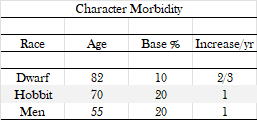
When a character is old, the Referee shall throw each spring to see if they will die in the following winter. If so, he will throw to set the date of death. Both of these throws will be held in secret. (It makes sense though for the Ref to mark that day on the calendar. When it approaches, you may want to tell the player beforehand so it is not a complete surprise.)
Starting at age 55, Men have a 20% chance to die of old age the following winter. That chance goes up 1% every subsequent year.
Dwarfs start getting old at 82. At that age, they have a 10% chance to die the following winter, which increases by 2 every third year.
Elfs do not have natural morbidity.
Starting at age 70, Hobbits have a 20% chance to die the following winter. That chance goes up 1% every subsequent year.
A character who is slated to die will die d% days after November 30.
25 December 2022
On Time
Gary famously said that you can’t have a meaningful campaign without strict timekeeping. He had his reasons and they were good reasons: an open table with up to 50 players playing in the same campaign world, dropping in and out as their schedule permitted. He has to keep strict time to keep the events of the campaign world straight for all of them!

Even if your campaign has different pressures and challenges than his early campaigns did, you will benefit from strict timekeeping as well.
In my campaign, we observe several time periods.
The Round is one minute long. This is good for fights, chases, holding your breath, beating the clock.
The Turn is ten minutes. This is good for exploration and problem-solving, torches and wandering monsters.
The Day is good for overland travel. It measures off healing, spell recovery, and brewing a potion among other things.
The week is good for spells and spell research. In my game, there are quite a few weeks during which adventuring is quite impossible, due to festivals, harvests, wars, diseases, bad omens, terrible weather, and simply healing up. Characters can spend some of those weeks doing other things like courting maidens and writing scrolls, for instance.
The season is helpful in the same way weeks are.
The year is very important because characters age and the state of the world at large will change. Favorite NPCs will die. PCs will retire and die. Babies who were born will come of age, and become potential PCs or helpful NPCs themselves.
I keep a calendar for this reason, with regular events and chances for unusual ones. There are “blue” weeks which are good for adventuring; “yellow” weeks which are good for town events; and “red” weeks and days, where characters are all going to be indisposed.
For in-game time, once into the dungeon and out again is usually one day, but sometimes longer if the several characters camp out somewhere.
No one moves or works on Sundays, Christian or not. Exertion is forbidden across Aluvia. There are other days when activity is strictly prohibited for religious reasons as well.
I’ve tried renaming the weekdays and months. It’s unnecessarily complicated. Saying January and Tuesday is much easier on the brain and doesn’t break verisimilitude.
NEXT TIME: Character Age and Aging
Subscribe to:
Posts (Atom)