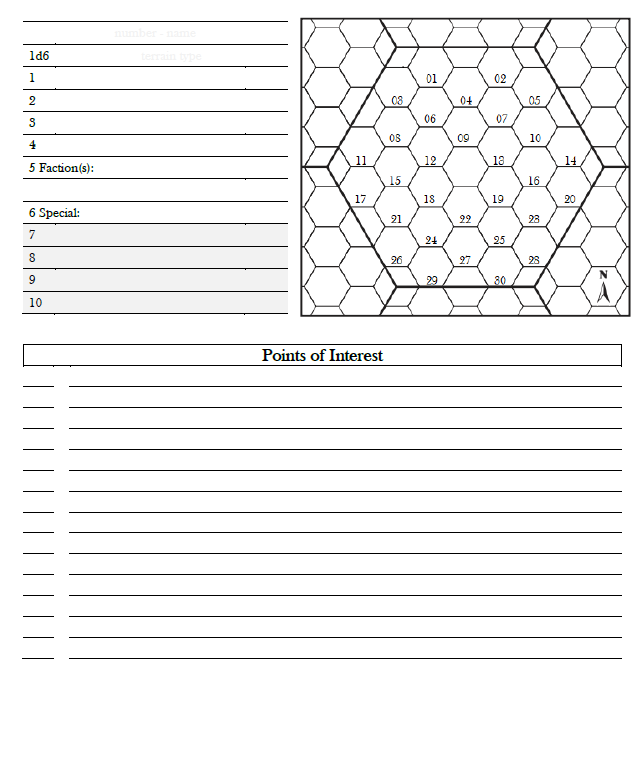
Here are two more-representative hexes. Each has an adventure and a wonder.



The wandering monster table has only four monster entries. This is because 1) there really won't be that many chances to roll on the table, which obviates the need for variety and 2) to enforce the idea that "this hex contains X" for any given hex.
When a monster entry comes up (or in some cases, the Faction entry I suppose) we roll on Table 1 as well to see what kind of encounter it will be.

The Faction entry shows who controls the hex, or in the case of a wild hex, the most likely named NPC or faction the party will encounter. This hex is adjacent to the fort ruled by Lord Atlan, so it is most likely you would meet his men or even himself (and I would shade toward the latter, because it's cool to meet named NPCs.)
The Special tells us that there is some feature in the hex; a town, village, landmark of note or wondrous locale.
 |
Cities are placed and marked on my map. Any time we roll a wonder for the second time in a hex, it is a landmark instead.

Her is my landmark generator. It is overly complex; I'm not sure what to do about it except just make stuff up at the play table. Maybe I should use it to generate some landmarks beforehand so I have a list? Here is a stable link to the .pdf.


A Message For You, Rudy
I think the Specials should be hex features: some landmarks, some wondrous locales, and some towns and villages. That means there have to be different charts for more-civilized and less-civilized regions.
I already use three levels of civilization for my domain rules so I’ll use the same ones here: civilized, borderlands and wilderlands. So I will have three subtables for the Special result, SC, SB and SW or S1, S2 and S3 (haven’t decided yet.) The correct subtable will be indicated on the appropriate main table.
Nested Special tables
Table SC Civilized
1 town
2 village
3 village
4 landmark
(Cities are always placed)
Table SB Borderlands
1 village
2 village
3 landmark
4 landmark
5 wandering merchant
6 wonder
Table SW Wilderlands
1 homestead
2 fort (landmark)
3 demihuman village
4 wonder
5 wonder
6 landmark
In any individual hex, there is a maximum of one wonder to discover. Once that hex’s wonder is discovered, that listing becomes a landmark instead.
This article originally appeared on February 23, 2018.
When someone plays D for the first time, they don't know what they don't know. This is a Really Good Thing.
Our friend Caty joined us for her maiden voyage into RPGs. She cast charm person on a goblin and bam! She had a very stupid henchman, but moderately useful because he could navigate through the other goblins. His name was Snotrocker. Sadly, he died (it was the best day of his life.) Caty's character kept his decrepit rusty short sword as a souvenir of the several Turns they spent as best friends.
Later, they fought a bugbear and his goblin
minions. I do the pumpkin-headed long and stringy bugbears. I showed them this
picture.

To their credit, they attempted parley, but they
got a terrible reaction check. So it was a fight! And Caty's wizard threw the
Sleep bomb. SHWAZOM! Dead!
So after they killed it, Caty says, "I'm going to take the seeds."
"..."
"..."
"...what seeds?"
"From his head. I'm going to take the seeds
from his pumpkin head and use them in my magic."
So I have decided they are Henchman Seeds.
Bugbear's heads are filled with seeds. They look
like pinkish pumpkin seeds. If you take 2 Turns to vivisect it, you can grab
out a few big handfuls of seeds weighing 1 lb.
If you plant these in your lab or a hothouse, 1d4 bugbear henchmen grow in 3 months.
Or you can sell them for 500 GP if there is
another wizard or something that wants henchmen.
I awarded the party 500 XP for the awesome idea.
And forever after, wizards who are In The Know will hunt bugbears for
their seeds, just as people hunt dragons and rocs for their eggs today.
There are two other parts to balancing encounters the old school way that we need to talk about. They are allowing the several players agency to set the goals for their adventure session, and giving the players game space to make decisions.
 |
| What? No Cleric? |
There is a text book's worth of analysis and basic and advanced rules for playing in this way, but the most important thing to remember is that the animating force of the adventures has to come from the player's side of the screen and not the Ref's side. If the Ref is telling the players what to do with their characters, that's a red flag.
So that's agency.
The other part of balancing encounters is that you need to leave room for the characters to progress slowly as well as quickly. For instance, the first dungeon level should have much more treasure and many more monsters and traps than it would take for the party to achieve second level. They don't hit second level and DING! head downstairs. That would be the Ref telling the players what to do! It's so critically important for the players to be able to keep their characters in the "shallow end" and for them to have meaningful content there as well.
That may mean putting five times as many rooms and five times as much treasure as they would need to hit level 2. It may mean restocking that dungeon level through some mechanism, such as new monsters from deeper in (but in this case, not tougher) lairing up closer to the surface. In reality, it's probably good to use both of these methods in tandem. In the Wilderlands, it's easy to say that the characters missed something on their first survey and there was more to be found after all, so that's a third way for you the Ref to provide more room for the characters and more agency for the players. Additionally, because of the open nature of a hexcrawl, there should be plenty of opportunities for characters to backtrack to unexplored areas they missed because of their direction of travel - more so than even in a dungeon.
And that's space.
Along with the critical relationship between risk, reward, and distance, player agency and the game space for characters to work in make it possible for old school encounters to balance in a different way from new school encounters. It happens in real time at the table and may result in real character death. These are exciting prospects which will bring your players back again and again.
This article originally appeared on July 19th, 2017.
 |
| Traffic Jam, Level 3A |
For those of you who are players of modern games, you will understand that the encounters that you face and the challenges you come upon are closely balanced to your level and party makeup. You are meant to be able to overcome each encounter and in many cases, it will be through making die rolls against skills, both combat and non-combat, that you careful chose for your characters beforehand. Player skill at the table gets rewarded, but the real skill comes before table time, where you build your man up from the many options available to you.
Not so with old school D&D. There was
certainly a system for encounter balancing but it has very little to do with
what the players and Referee do before table time. The Referee does prepare
encounters and place them, or make rosters of wandering monsters for various
areas. But the balancing act of party strength versus encounter danger
happens at the table in real time.
You might remember that we observed the relationship between XP (the measure of personal power), encumbrance, speed, and equipment. They are all inextricably linked to each other through the touchstone of the gold piece. But let's go a little further now and link the gold piece up to dungeon levels.
The first dungeon level is the one closest to the surface world. We know this to be true because it is a given in the game. The weakest monsters and traps guard the least of the many treasures in the Underworld. Not only are they meager, but they are usually composed of relatively heavy objects, such as copper pieces or perhaps sacks of grain. Deeper levels hold greater danger, but also contain greater treasures.
Therefore it is up to the several players to decide what level of risk/reward they wish to pursue. The greater danger guards greater rewards, and therefore the depth below ground (or similar distance) guards faster advancement in terms of XP.
Likewise, there ought to be a simple way for the several players to know how dangerous the Wilderlands can become. One simple way is to say that the hex that contains a town is Civilized and within it, dangers will be those of civilization. Things will be "normal." Two hexes hence will be the weird Borderlands, where dangers of a wild and sometimes magical nature may reside. Past that is true Wilderlands where one must be prepared for anything, because it's impossible to say what is out there.
In any case, keeping that relationship between distance, risk, and reward is how the Referee keeps encounters balanced. Let this be your lesson: If the Referee does it well enough, the players will trust him and the table will have more fun, and play together longer.
We are taught as beginning Referees to construct random encounter tables on a bell curve. After all, mundane encounters (with men and common humanoids) will be much more common than ones with great and dangerous beasts.
This makes logical sense, but it doesn’t make for much fun. Why always the normal stuff? Why wouldn’t you want to throw cool monsters at the players? Bandits? They can see bandits every day. Give them the cockatrice or wyvern or displacer beast or a weird old illusionist.

Random encounters are rare enough: we only check for them once every so often. When one comes up, it should have the “wow” factor that will have players retelling their encounter for years. Therefore rather than bell-curve encounter tables, we will construct straight tables.
For each terrain type or biome, write down as many kinds of odd men and monsters that you like that might dwell there. Try to think up 10-12 entries. Then arrange these men and monsters into a list by ascending threat level. We call this a progressive encounter table.
At the outskirts of the biome, just roll 1d6 to see what comes up. But as you get deeper into it, it should get more dangerous, like going deeper into a dungeon. At deeper dungeon levels, things are more dangerous. In order to simulate this ramp up in danger, add some integer to your 1d6 roll. 1d6+1, 1d6+2, 1d6+10, whatever. Call this integer your hazard level. Since you arranged your denizens in ascending-threat order, your adjusted rolls will produce more dangerous encounters without the players feeling like it’s forced.
For small hexes, like a 1-mile hex, choose a single hazard value for the whole hex. But if you’re doing a six-mile hex, it’s okay to eyeball the territory and adjust the hazard value on the fly. A forest hex near farmland and a swamp would likely have an increasing hazard gradient as the party goes from dry land into the bayou.
Monster, Activity, Complication
Random tables are
good to use because they can bring the world to life. But if each time the
players meet monsters, they’re always doing the same things, then the world’s
verisimilitude breaks down. Why is the monster there? Is he always just waiting
to be killed? Of course not! Therefore, consider constructing three-column
tables.
The first column will be the monsters, as usual.
The second column will be six activities the monsters might be doing when the party encounters them. Hiding, patrolling, foraging, partying, healing a sick friend, looking to trade, on the prowl. Who knows? Just pick six obvious activities.
The third will be a complication the monster will have. Write down six things that might inconvenience a monster. Maybe it has a baby. Maybe it’s sick. Maybe it needs help with another monster. Maybe it’s being preyed upon right now by an even bigger monster!
By rolling on all three of these columns, you will have a monster, a purpose, and a complication – a ready-made interesting and vibrant encounter.
It will also give the players some information on how to shape the encounter to their advantage, and players love “fooling” the Ref. So let them
Here’s my chart for the Barren Steppe biome:

If I roll a 4, 1, and 4, then I have Dervishes, skulking about, but they need something the party might have – and they want to trade for it. Much more interesting than just some random holy men.
Try straight,
progressive, three-roll tables in your next game.