I made this. It scratches the itches I need scratched for sandbox info. Here are links to the .doc file and the .pdf.
Whatever do you think of this?
 |
| A moderate amount of prep. |
Driving around in the city looking at the street signs and the Google map, it’s clear that before the advent of the car, place names referred to much smaller areas. Inside a city the size of providence (175k) there are 39 neighborhoods or something stupid like that.
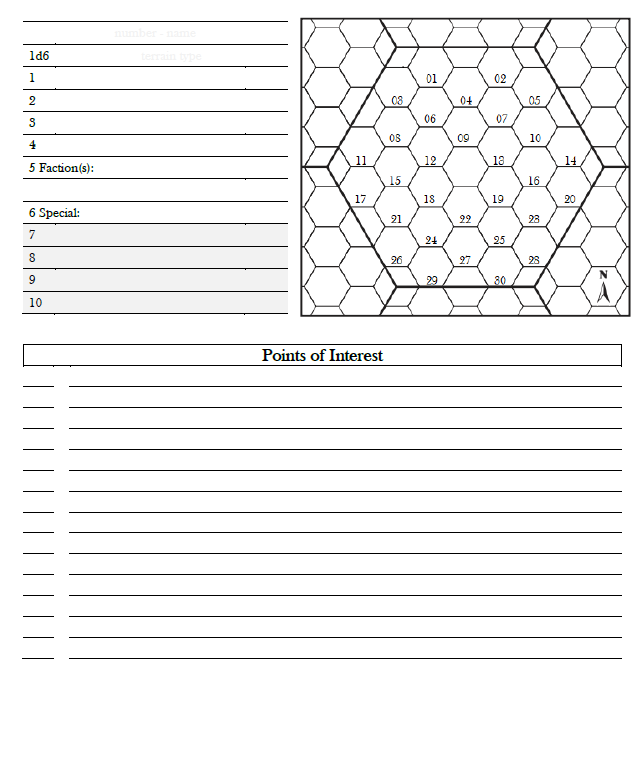
So I have decided, just decided right this minute, that I am going to give a place name to literally every hex on the board.
This will help establish flavor and make the world seem bigger than it is. Every time the several players cross into a hex and meet someone local, we can say “this is Durkwood” or “this is Elm Grove” or whatever.
I’ve kinda decided to use about 35 different random encounter tables anyway - one for every two or three areas. Might need more. Why not continue down this delicious path?
After crossing through lands x, y, z, a, b, c, the several players will feel a much greater sense of accomplishment than “you cross three hexes today. They are forests.”
Additionally, settled areas have a village every one or two miles. Borderlands have a settlement every five to ten miles. So those will have to be on the encounter tables too, in some fashion. Probably nested tables.
The essence of play in the folkstyle of D&D is to push into unknown places, to explore, to meet new people, to acquire resources such as gold, magic items, allies and land, and to eventually build your very own domain where you can be the Lord andmold the world in your image.
To begin a campaign, some folks will want to start with the whole continent and kingdom. That’s fine. It’s fun. There are a lot of tools to help keep track of a whole world. But you don’t have to do nearly so much. In fact, if your goal is to get started in a reasonable amount of time and with a manageable amount of prep, then coloring in the whole world map is quite inefficient. We do not need a world; we need a neighborhood.
1. Devise the premise of the world. That is, explain the nature of your specific game in a few sentences. What makes your campaign world special? Make it so you can tell someone what’s special about it in under one minute or print the information on one side of a business card. Consider your tone, what races and classes will be available, and what is special about your particular world.
2.
Think about one six-mile hex and then its surrounding hexes. That’s seven hexes and a total of
224 square miles. Place your starting town in the middle of the map. Realistic
medieval cities and towns take up no more than a single one-mile hex. Consider
water and food sources. Consider defense.
Then place the entrance to a dungeon somewhere nearby. Other points of interest can be generated procedurally as you go along. A village every 2-3 miles and a castle or fort every 12-15, a witch’s coven, an accursed fairytale forest, a goblin redoubt, a magical stone circle, a guard golem who dispenses quests and rewards. All of these can come later. The really important things are the haven of town and the entrance to the adventure site.
3. Map out at least three levels of the starting dungeon. Each level should have a theme of some kind to distinguish it from the other levels. A good guideline is that the first level should have about 7-13 rooms, the second 13-25, and the third 25-30. Not every level has to be bigger than the one above it; these are only suggestions. We will talk more about just how to do that later on.
4.
Go back and draw the layout of
the starting town. Think up some inhabitants. The party will need some shops to
buy and sell, a place to sleep, a place to hire henchmen, a reason adventurous
men may be available for hire, a place to hear rumors, and two or more power
centers.
Power centers could include a chaotic temple, a thieves’ guild, a septarch’s tower, a league of fighters’ hall, NPCs of various backgrounds, roles and secrets.
5. If the starting town does not have a castle or fort, place at least one within a day’s travel – about 12 miles. Consider placing a couple of towns 5-10 miles away from one another too. Use several kinds of terrain surrounding the starting town, for terrain provides the players with meaningful choices. Place roads and other pathways in logical places and at a logical technological levels.
Going through the steps above, this is what I have devised.
6. Premise: The starting realm will resemble medieval northwest europe c. 1100. There will be three races (phenotypes) of Men, but the vast majority of NPCs will be Aluvian, the White European analogue. Starting classes are limited to fighter, wizard and cleric; and demi-men are limited to dwarf, elf and hobbit with race-as-class rules. Level cap is 14 and there are not many people in the world who have reached level 9. All classes other than fighting-man will be rare and exotic. At any one time, only 40% of the PCs can be demi-men; the balance must be human. This is to enforce the human-centric nature of adventuring. The several players shall decide among themselves who gets to play the demi-men, should there be excess demand. Most D&D monsters will be present. Some monsters will be new. Some monstrous races will be presented as unique individuals rather than myriad.
7. Starting location: The town is named for Thorsten Cragstone, a legendary Aluvian general. Lore has it that he founded the town and he is buried somehwhere nearby. There is an impressive patinaed bronze statue to him in the middle of town, even though no one really knows what he looked like. Whosoever is in town when the church bells ring noon gathers before the statue and pledges their allegiance to it, as it is the embodiment of Cragstone’s fighting spirit. The townspeople believe they are all descendants of his or of his friend Zenopus the Septarch, or of both. When a man from Cragstone swears an oath, he will say, “by Cragstone’s beard,” or “by the crook’d staff of Zenopus,” or perhaps simply, “by the Founders.”

It is
located at an elbow in the Rith, which is a broad, slow river with ample
littoral marshlands. It has average quality farmland. The locals are known for
their honey and their candle wax, since beekeeping is a point of pride.
Because of its location on the river and halfway between the towns of Rithwic and Glenden Wood, it is also known as a decent market town. In addition to the permanent shops, there is a paddock down by the river where merchants will sell wares from their wagons. There’s a small chance that you can find just about anything down there, and a slightly smaller chance you can sell just about anything.
Demographically,
Cragstone is a town of 100 families. At least one is Dwarven; at least two are Hobbit;
none are Elven (PCs aside.) There is one G’harundim woman in town who is the
jeweler. (G’harundim are a North African type of people.) The rest of the town
of course is made up of Aluvian Men and their kin.
Since this is the starting town, I can be certain that we will spend at least several sessions there. Therefore it makes sense to stock it with lots of NPCs. I have created about 50 NPCs to be “the people in the neighborhood.” Name, race, job, most common locations. This includes the town guard and a number of ne’er-do-wells from which henchmen can be hired. I have also established several craftsmen who will be useful to the players for specific equipment, information, and to buy unusual items they may find. I don’t know how much the players will decide to utilize any of these resources, but they’re available.

The power centers in town are threefold: There are two churches (one Catholic and one Protestant) and there is a sheriff named Lieutenant Kenneth who leads the town guard and acts as the chief civil authority in town. He is a neutral Hero, or fourth-level fighting-man. The town has one true cleric, a first level Lawful named Edrick the Coward and one second-level fighter who acts as Kenneth’s sergeant.
I have not assigned traits to any NPCs in advance since I prefer to assign them procedurally as I go along. That way, I can be surprised and delighted right along with the several other players.

It’s about the same size as Zimbabwe.
The lone yellow hex is the location of the starting town of Cragstone.
It sits at about 30 degrees south latitude. Winds are minor and changeable and the ocean currents are from the east-northeast.
It’s not done of course. Need more rivers, nothing is named, no points of interest.
The players will be able to see this version of the map but they will not have access to a marked up version.
The map we use will a much smaller regional map. The first map we use will only show that starting hex.
