
These are cheap ways to give the players a feeling of being in a magical realm, and may function as a silver bullet in their time of need.
Also remind them that giving gifts to your followers will encourage loyalty.

When I first learned about the multiclassing rules for elf and half-elf fighter/mages, I was really bummed out. Not only do they take a significant cut in their number of hit points (half d10 and half d4,) but they can’t wear armor when they cast spells.
Lol what?
What kind of a fighter can’t wear armor?!
I imagined that the elf would have his magic plate mail in his backpack. Once he blew through his offensive spells, he would cast his defensive magic, put on his armor, and pick up a sword.
This seemed stupid to me, especially with fewer hit points.
I never played one. I did have one half-elf fighter/mage/thief but that was a short-lived experiment for some reason.
I much preferred the Arensonian Elf class, where the elf was a fighter all the time and a wizard all the time. I got that. Even though they need hilariously high XP to level 2 (and then trail by at least one,) the idea of a sword and armor AND spells made sense.
 |
This clearly illustrates my fighter-bias, and even my specific melee-bias. Yes, I’m well biased towards melee types. Crown & Valor makes an effort to swing the power balance back in favor of melee toons.
Later on, I realized the world building implications of the elf casting without armor; the cold-iron-and-faerie-dust aspect of it all, and so now, I can appreciate that for what it is and what it says about that multiverse.
I might even try one the next time there’s a 1e game to be had.
|
Hollow Weapons
Hollow weapons are special weapons
which ignore magical wards and banes. Missile weapons impart the hollow quality
to their ammunition. There are three known keyworded types.
· Lifehollow weapons ignore
magic spells as well as inborn properties which require a weapon to be magic in
order to damage the target.
· Banehollow weapons ignore
magical plusses from armor and similar artificial defenses.
· Truehollow weapons ignore
both types of protection.
Hollow weapons are partially
translucent, appearing as if made from smoked glass instead of their normal
material. No hollow weapon may have any magic spell cast on it, nor can it have
a magical plus to hit or damage. If a character wields such a weapon it is
impossible to hide in the dark because it emits a dim pink and blue nimbus at
all times, clearly visible in the dark.
Chorizite
Hollow weapons take advantage of the
antimagic properties of the mineral Chorizite. Chorizite ore is quite valuable,
trading at 100:1 with gold by weight (1,000 GP per pound.)
An alchemist, hedge wizard, magic-user
or elf can imbue a potion with the pink, chalky ore and then a blacksmith or
weaponsmith can imbue a weapon with hollow qualities. One weapon can be so
imbued with 10cn worth of Chorizite valued at 1,000 GP plus 50 GP for the
alchemist’s labor and expertise. Each time a weapon is imbued it will gain one
property, based on the kind of Chorizite potion the alchemist makes.
Each Chorizite potion takes
one day and 50 GP in materials; a finished potion sells for 1,100 GP.
A blacksmith takes one day to imbue a
weapon with the potion at a cost of 100 GP.
The entire process takes locating some
Chorizite, two days, and 1,200.
Other uses for Chorizite
Chorizite potions can be used to
attempt to strip the magic from a magic item. This takes one hour and can be
performed by anyone.
Chorizite can be applied to other
permanent items such as shields, armor, equipment, etc.; this makes the items
immune from enchantments of any kind, including magical enhancement.
Can chorizite be applied to a container
or even a room? Perhaps...
| ||
Bloodhunting Weapons
Bloodhunting weapons are infused with Bloodhunter
Oil. When a Bloodhunter weapon hits and damage is rolled, reroll all
die rolls of 1 or less.
Making Bloodhunter Oil
This special infusion is made from the
bodies of magical predators such as Bulettes or Hell Hounds, or the bodies of
demons, and is therefore both rare and expensive. An alchemist, Hedge Wizard,
Elf or Magic-User can make up to six doses at a time, which takes a week. One
application of Bloodhunter Oil costs 2,000 GP. An alchemist can make it from
seven pounds of appropriate flesh. This oil can be applied by a blacksmith or
weaponsmith. A bow so enchanted confers this property to its arrows but a sling
cannot be so enchanted.
Creatures without blood or some analog
are not affected by this quality. Thing such as golems, zombies and gargoyles,
for instance, are immune.
Bloodhunter Oil can be applied to
hollow weapons and vice-versa.
Do dwarves and hobbits have wizards of their races? The answer is yes. Dwarfs especially use magic for knowledge and defense. However, there are two reasons why we do not see the magic-users of these races. One is that it takes a large investment to raise up a wizard. The practitioner is simply too valuable to allow such agency and the wizard has great responsibility to his fellows. The other is that adventuring is a fundamentally human pursuit. The other races do not do it much, and those who do tend to be the black sheep of their communities. Therefore, is very rare indeed for outsiders to meet or recognize wizards among the shorter kinds.

On the topic of Clerics, demikind come to religion in their own ways, but each can indeed call upon the power of God for great miracles. And again, you will likely never see such a demi -man, for they who do such don’t do adventuring.


A Ritual is a complex ceremony that creates a magic effect. You must read it from a book or scroll containing it.

Arcane rituals can be made from the spellbook spells they are based on. The time and is the same as making a scroll: one day per spell level, but the cost is one-tenth that of a normal spell scroll: 10 x spell level x spell level in GP. This ritual instruction is inscribed into a ritual book like a normal spell is inscribed into a normal spellbook. Each ritual scroll may be used only once. It is consumed by using the ritual.
Anyone who can read Common can use a ritual book to perform the ritual it contains. They must have the appropriate material components and those components are expended. It takes one Turn per spell level of the original spell to perform a ritual, or at least 10 minutes.
A Ritual Book: Like a spellbook, a ritual book is the repository of the information needed to perform a ritual. It costs 50 gp. It weighs 50 cn. It has 128 pages. Each ritual instruction takes up a number of pages equal to the spell’s level. Ritual books may be found as treasure. Roll the spell rituals inscribed as normal.
You may create a new ritual book by copying an old one. It takes one day per page and an INT check for each ritual (or WIS check for Clerical rituals.) A missed check means a ruined ritual and messed up pages in your book. You can’t re-use those pages.
Learning a Ritual: It takes at least 8 uninterrupted hours to learn how to perform a Ritual. At the end of that time you make an INT or WIS check to see if you have learned it. A failed check means you have to spend 8 more hours learning it. Spending time with an appropriate Magic-User or Cleric teacher, who knows the spell to be studied, means you don’t need to make the INT or WIS check.
In this way a Fighter can cast Cure Light Wounds or Detect Magic if he needs it. Combat spells don’t work as well because they take so long to cast.
There are three other regular classes and three minor classes (lower power level) but these are the ones I want to make available at the start of the campaign.
As follows:
When you devise your character, one important choice to make is his character class. Character class will determine what special abilities you may use to interact with the environment, such as casting magic spells or becoming a master swordsman.
There are six classes to choose from. Three are human professions, and three are the demi-human races of Dwarf, Elf and Hobbit.
Humans hear a faint noise on a 1 on 1d6 and have no other special detection abilities. However, they have no restrictions based on race, and they can reach level 14 in any of their classes. Here are the three human classes:
Clerics are holy warriors. Clerics use any armor and shield, and can use any blunt weapon. They are always Lawful. They can turn (scare away) undead, they know special secrets about how to fight horrible monsters, they perform miracles, and they can write scrolls. They have the most favorable XP chart of all classes.
Fighting-Men are great leaders. They can use any weapon or shield, and any weapon including special magic swords. They get special combat advantages, special social interaction advantages, and have the most prestige among the realms of men.
Magic-Users (or Wizards) use the most powerful kind of magic: arcane spells. They create magic items of every kind. They are the nuclear weapons of the fantasy medieval world, but start out somewhat weak.
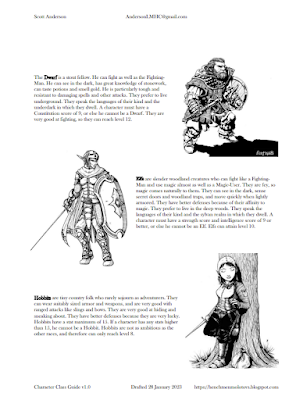
Dwarfs are stout. A character must have a Constitution of 9 or better or else he cannot be a Dwarf. They can use any armor and shield, and any short weapon. They can carry extra loot, but move slow. They can see in the dark, can smell gold, can test potions by taste, are experts at stonework, and have exceptionally good saving throws. They speak some extra languages of their kind. Dwarfs can attain level 12.

Elfs are fey. A character must have a Strength and Intelligence of 9 or better or else he cannot be an Elf. They can use any armor and shield and use almost every weapon, as well as using arcane magic. Lightly-encumbered elfs move faster than any other character. They can see in the dark, and have special senses for the wilderlands and regarding secret doors. They speak some extra languages of their kind. Elfs can reach level 10.
Hobbits are tiny country folk. If a character has any primary stat higher than 15, they cannot be a hobbit. Hobbits can wear any armor and carry a shield, but it must be properly sized. They can use any small weapon. Hobbits are very good at hiding and sneaking, and have exceptional aim. Hobbits can attain level 8.


