Showing posts with label dwarf. Show all posts

02 February 2023

Dwarf and Hobbit Spellshapers

Do dwarves and hobbits have wizards of their races? The answer is yes. Dwarfs especially use magic for knowledge and defense. However, there are two reasons why we do not see the magic-users of these races. One is that it takes a large investment to raise up a wizard. The practitioner is simply too valuable to allow such agency and the wizard has great responsibility to his fellows. The other is that adventuring is a fundamentally human pursuit. The other races do not do it much, and those who do tend to be the black sheep of their communities. Therefore, is very rare indeed for outsiders to meet or recognize wizards among the shorter kinds. 


On the topic of Clerics, demikind come to religion in their own ways, but each can indeed call upon the power of God for great miracles.  And again, you will likely never see such a demi -man, for they who do such don’t do adventuring.  

30 January 2023

Cyfandil Starting Classes

This is the quick start page I'm going to hand out when we are ready to roll up our first characters. These are the big six (with a hidden seventh) but there are other classes which I will reveal in time. 


Here is the text: 

Quick Start Class Guide
 

You can get a copy of the PDF here.


21 January 2023

Revised Chargen Info Part II


What do you guys think about this description of the classes in my game? I want a brand-new player to be able to make a quick decision about what to play (and then help every player make decisions about his Bullpen characters.)

There are three other regular classes and three minor classes (lower power level) but these are the ones I want to make available at the start of the campaign. 


As follows: 


When you devise your character, one important choice to make is his character class. Character class will determine what special abilities you may use to interact with the environment, such as casting magic spells or becoming a master swordsman.


There are six classes to choose from. Three are human professions, and three are the demi-human races of Dwarf, Elf and Hobbit. 


Humans hear a faint noise on a 1 on 1d6 and have no other special detection abilities. However, they have no restrictions based on race, and they can reach level 14 in any of their classes. Here are the three human classes:


Clerics are holy warriors. Clerics use any armor and shield, and can use any blunt weapon. They are always Lawful. They can turn (scare away) undead, they know special secrets about how to fight horrible monsters, they perform miracles, and they can write scrolls. They have the most favorable XP chart of all classes. 


Fighting-Men are great leaders. They can use any weapon or shield, and any weapon including special magic swords. They get special combat advantages, special social interaction advantages, and have the most prestige among the realms of men. 


Magic-Users (or Wizards) use the most powerful kind of magic: arcane spells. They create magic items of every kind. They are the nuclear weapons of the fantasy medieval world, but start out somewhat weak. 


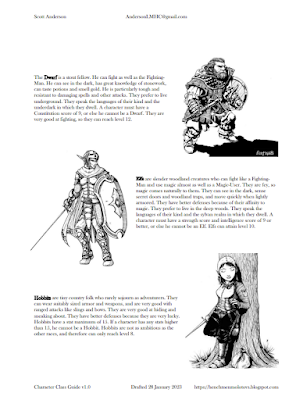
Dwarfs are stout. A character must have a Constitution of 9 or better or else he cannot be a Dwarf. They can use any armor and shield, and any short weapon. They can carry extra loot, but move slow. They can see in the dark, can smell gold, can test potions by taste, are experts at stonework, and have exceptionally good saving throws. They speak some extra languages of their kind. Dwarfs can attain level 12. 


Elfs are fey. A character must have a Strength and Intelligence of 9 or better or else he cannot be an Elf. They can use any armor and shield and use almost every weapon, as well as using arcane magic. Lightly-encumbered elfs move faster than any other character. They can see in the dark, and have special senses for the wilderlands and regarding secret doors. They speak some extra languages of their kind. Elfs can reach level 10. 


Hobbits are tiny country folk. If a character has any primary stat higher than 15, they cannot be a hobbit. Hobbits can wear any armor and carry a shield, but it must be properly sized. They can use any small weapon. Hobbits are very good at hiding and sneaking, and have exceptional aim. Hobbits can attain level 8.

17 January 2023

Awarding spells to Elves and Magic-Users

We covered the game-mechanical process of collecting new spells in a prior post, but today we will discuss the in-game process of getting new spells and the worldbuilding implications of same. 


We begin by saying that there are only 78 spells: 13 per level times six spell levels. 


A magic-user or elf will start the game having four spells in his spellbook. Two of them are standards that every arcanist must know: Read Magic and Detect Magic. Then we grant two first-level spells: one chosen, and the other assigned at random from the remaining ten. How do arcane casters gain more?


The answer is, they must find them as treasure, capture them from a worthy foe, or negotiate for them with other magic-using types. 


A human or elf spellcaster will never give a spell away. They are the nuclear weapons of D&D, far too valuable to give away gratis. Nor is it likely that a dweomerist will trade a spell, level for level. 


An elf or human wizard who is particularly hard up may sell the knowledge of a spell to a trusted colleague, but never for less than 1,000 GP per spell level, and probably not at all. Usually double this, some some significant magic item, or a quest. 


Henchmen, retainer and hireling NPCs may not want to deal with this at all, and then only with a significant bonus. They will outright refuse PCs who are not their master.


More likely than this, a wizard or dragon may bestow the new spell upon a PC in exchange for exceptional service or the gift of a magic item. 


A sure, albeit expensive way to gain spells is through spell research. In this world, the wizard must have access to a laboratory and library worth no less than 1,000 GP per spell level researched: 1,000 GP for first, 2,000 GP for second, etc. This redoubt takes a month per spell level to construct and can be expanded as needed, provided there is room (but cannot be moved.) Then the wizard must spend 1,000 GP and one week per spell level researched. At the end of the week, the player makes an INT roll to see if the spell is successfully researched. 


Another benefit of the lab is that the player, along with the Referee, may think up a spell not in the list of 78 for that wizard to acquire. 


The most common way to gain new spells, though, is to discover them in old books and scrolls sconced in treasure hoards. By means of Read Magic and a little luck (INT roll,) the endwimmerist in question can add any of the spells to his book. This will destroy a scroll but will not damage a spellbook. 


It takes one day per spell level to copy the spell, and any level spell can be copied even if it is beyond the mentalist’s casting ability at that time. The wizard cannot simply cast the spell from the book, however, because each wizard uses his own cypher to record such secret knowledge. 


These processes suggest certain elements of the setting. Spells are rare and very valuable. There are only a few true wizards, and many will know other wizards by reputation. There used to be more wizards, as evidenced by the many scrolls and books left in hoards. Collecting spells is one way for the wizard to remember his adventures and journeys, for each one will come to him through some unique interaction with the game world. 


On Dwarf and Hobbit arcanists


Do dwarves and hobbits have wizards of their races? The answer is yes. Dwarfs especially use magic for knowledge and defense. However, there are two reasons why we do not see the magic-users of these races. One is that it takes a large investment to raise up a wizard. The practitioner is simply too valuable to allow such agency and the wizard has great responsibility to his fellows. The other is that adventuring is a fundamentally human pursuit. The other races do not do it much, and those who do tend to be the black sheep of their communities. Therefore, is very rare indeed for outsiders to meet or recognize wizards among the shorter kinds.