Showing posts with label fighting-man. Show all posts

16 March 2023

The Elf Issue

 When I first learned about the multiclassing rules for elf and half-elf fighter/mages, I was really bummed out. Not only do they take a significant cut in their number of hit points (half d10 and half d4,) but they can’t wear armor when they cast spells. 


Lol what? 


What kind of a fighter can’t wear armor?!


I imagined that the elf would have his magic plate mail in his backpack. Once he blew through his offensive spells, he would cast his defensive magic, put on his armor, and pick up a sword. 


This seemed stupid to me, especially with fewer hit points. 


I never played one. I did have one half-elf fighter/mage/thief but that was a short-lived experiment for some reason. 


I much preferred the Arensonian Elf class, where the elf was a fighter all the time and a wizard all the time. I got that. Even though they need hilariously high XP to level 2 (and then trail by at least one,) the idea of a sword and armor AND spells made sense. 


This clearly illustrates my fighter-bias, and even my specific melee-bias. Yes, I’m well biased towards melee types. Crown & Valor makes an effort to swing the power balance back in favor of melee toons. 


Later on, I realized the world building implications of the elf casting without armor; the cold-iron-and-faerie-dust aspect of it all, and so now, I can appreciate that for what it is and what it says about that multiverse. 


I might even try one the next time there’s a 1e game to be had. 

23 February 2023

Magic Swords are a Fighting-Man Class Ability

In the old game, 20% of all magic items are swords. Only Fighting-Men can use swords. 


AND THEY ARE AWESOME.


They all talk and they all have personalities.

They all have special powers to be discovered.

They all have cool lore for me to invent later on.


It actually take a little bit of time to craft an AWESOME magic sword worthy of the name. So I put together a little list of a few for when they hit the treasure hoards. 


At some point if this becomes a really important thing to the players, I may even decide to place them rather than rolling them randomly.


Because we're doing race as class, I think that Fighting-Men, Dwarfs, Elfs and Hobbits will all be able to use magic swords. But Dwarfs won't be able to use Claymores and Hobbits will only be able to use Backswords, on account of their smaller sizes.


But here are the first three swords that will hit the table as we play.


Nightbane

Lawful

Int 9 +1/+2 vs undead, Ego 2

Telepathic with wielder and speaks Lawful

Motivation: kill undead types

Forged by the ancient Dandol people, long departed from this realm.

Minor power: place sword on ground for 1 Turn and it will point in the direction of the nearest potable water

Blade of steel and grip of stone

True name is lost to mortal men. Requires speaking with an Outsider, a specific long-dead sage named Osran Crimson, or a Wish

When the wielder’s HP fall below 11, roll d6. On a 6 the sword takes over.


Assurance

Neutral

Int 9 +1, Ego 5. +1 sword.

Motivation: Renown only

Telepathic with wielder and speaks Common

Forged by the mad wizard Apius

Minor power: once per week it can reveal the veracity of a rumor

Blade of steel, grip of emerald

True name is revealed when held by an honest man. (the ivory inlay has a monk holding it aloft.)

When the wielder’s HP falls below 14, roll d6. On a 6 the sword takes over.


Fortune’s Lantern

Chaotic

Int 7, Ego 2. +1 sword.

Motivation: Renown only

Telepathic with wielder

Forged by the mad wizard Ogast

Minor power: reveal any hidden thief or ninja-types within 60’

Blade of steel, grip of horn

True name inlaid upon the blade in a forgotten language

When the wielder’s HP falls below 9, roll 1d6. On a 6, the sword takes over.


17 February 2023

OSR Kensei Class

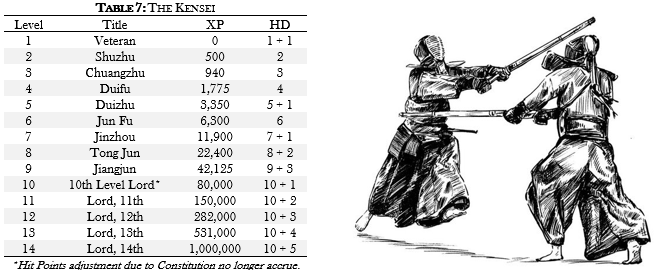
Cyfandil has an Asian-heritage region. If the several players want to visit, I think there ought to be some differences besides architecture. In addition to some different monsters (mostly ghosts and demons) and magic items, I'll construct at least a couple of classes that characters can encounter or even choose for themselves. I based the Kensei class on the Fighting-Man class. I think it's probably slightly weaker overall because kensei cannot take advantage of armor, shields and helms; they also do not have the inherent unit leadership structure advantages of the fighting-man, but they do retain the bonuses to attract and retain Retainers. 

A couple of their abilities begin at level 2 instead of 4 for the fighter: demon sense (a replacement for sense invisible) and great bravery. Potentially, great bravery will be very useful at the lower levels. 


The Kensei 


The Kensei is an unarmored warrior from Sho lands. He is excellent with one- or two-handed weapons but does not use any armor. Instead, he trains in techniques which make him naturally harder to hit.
          When a Fighting-Man reaches at least second level, he may convert his Fighting-Man levels to Kensei levels, and foreverafter progress in the Kensei class.
          However, the Kensei candidate must have both a Wisdom and Dexterity of 14 or better in order to assume the class. Additionally, he must know the Ponta language, which is the common tongue of the lands of the Sho people.
          The Prime Requisites of the kensi class are Wisdom and Dexterity. A Kensei with a Wisdom and Dexterity of 14 or more gains a +20% adjustment to all earned XP.

The Kensei’s Class Abilities:

Arms & Armor: The Kensei uses no armor nor shield. He may use any weapon including the most powerful magic swords.
 
Unarmored Fighting: When wearing no armor, the Kensei enjoys a bonus to his armor class equal to (WIS – 10) or (DEX – 10,) whichever is better.
 
Weapon Specialization: The Kensei always gets +1 to his damage roll when he hits his opponent. This is in addition to any bonus due from other sources.
 
Mantle of Leadership: A Kensei may have one more Retainer than his CHA would normally indicate. Any henchmen he leads get a +1 on their Morale checks.
 
Cleave: When in melee with people or creatures with fewer Hit Dice than himself, the Kensei may make one attack against each adjacent figure rather than a single attack against a single figure. However, this attack is resolved on the Fighting-Man 1-3 line of the attack matrix (rather than his normal line, if different.) Opponents of 4 Hit Dice or more are immune to this special attack.
 
Critical Hit: If a Kensei attacks a foe with an attack which is able to damage the target, and the player rolls a natural 20 (before any adjustments), the target is brought immediately to 0 Hit Points. He may damage creatures that have magical immunities using normal weapons.
 
Demon Sense: The Kensei may sense unseen demons and undead. This ability works out to 30’ (3 scale inches indoors and 1 scale inch outdoors.)
 
Great Bravery: Kensei are immune to fear, including magical fear.
          In addition, strarting at Level 4, they force an immediate Morale check by their opponents when they cross within melee range (3 scale inches) with 1 HD normal-types.
 
Forge Lore: At level 9 and above, Kensei may craft weapons in their strongholds using the same rules as Magic-Users do. They may not craft other kinds of magic items.


10 February 2023

Revised Fighting-Man Level Titles

The “boring old fighter” trope has always bothered me. It’s also spawned many combat classes with different wrinkles, as if being the best at fighting in a game that features good fighting isn’t enough. 


Awesome like this. 

I have given a lot of thought on how to — not necessarily improve the fighting-man class, but to change a player’s eye level when he looks at the class. 


I’ve decided to restrict commanding military operations to the fighting-man. The higher the level, the more troops he can command on a battlefield. I did the math and I think a 10th level Lord can command almost 27,000 men; a few directly, but most through a solid chain of command structure. 


This is why every evil wizard has a fighter in tow. This is why kings are kings: they have the loyalty of great fighting-men. 


Therefore there is a lot of implied setting here. Fighting-men are not just better at this particular thing; being a fighting-man affords political power and respect that a plain old +1 arming sword cannot. 


And from there, it is obvious I should change the level titles. Here they are:


Alt. Fighter ranks 


Veteran 1st

Sergeant 2nd

Lieutenant 3rd

  • can lead 10x level men 

Captain or Hero 4th

Centurion 5th

Tribune 6th

Legate 7th

Prefect 8th

  • can lead 20x level men and additionally 2 of the next lowest rank 

Lord 9th

30 January 2023

Cyfandil Starting Classes

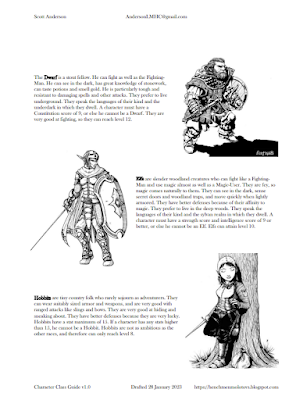
This is the quick start page I'm going to hand out when we are ready to roll up our first characters. These are the big six (with a hidden seventh) but there are other classes which I will reveal in time. 


Here is the text: 

Quick Start Class Guide
 

You can get a copy of the PDF here.


21 January 2023

Revised Chargen Info Part II


What do you guys think about this description of the classes in my game? I want a brand-new player to be able to make a quick decision about what to play (and then help every player make decisions about his Bullpen characters.)

There are three other regular classes and three minor classes (lower power level) but these are the ones I want to make available at the start of the campaign. 


As follows: 


When you devise your character, one important choice to make is his character class. Character class will determine what special abilities you may use to interact with the environment, such as casting magic spells or becoming a master swordsman.


There are six classes to choose from. Three are human professions, and three are the demi-human races of Dwarf, Elf and Hobbit. 


Humans hear a faint noise on a 1 on 1d6 and have no other special detection abilities. However, they have no restrictions based on race, and they can reach level 14 in any of their classes. Here are the three human classes:


Clerics are holy warriors. Clerics use any armor and shield, and can use any blunt weapon. They are always Lawful. They can turn (scare away) undead, they know special secrets about how to fight horrible monsters, they perform miracles, and they can write scrolls. They have the most favorable XP chart of all classes. 


Fighting-Men are great leaders. They can use any weapon or shield, and any weapon including special magic swords. They get special combat advantages, special social interaction advantages, and have the most prestige among the realms of men. 


Magic-Users (or Wizards) use the most powerful kind of magic: arcane spells. They create magic items of every kind. They are the nuclear weapons of the fantasy medieval world, but start out somewhat weak. 


Dwarfs are stout. A character must have a Constitution of 9 or better or else he cannot be a Dwarf. They can use any armor and shield, and any short weapon. They can carry extra loot, but move slow. They can see in the dark, can smell gold, can test potions by taste, are experts at stonework, and have exceptionally good saving throws. They speak some extra languages of their kind. Dwarfs can attain level 12. 


Elfs are fey. A character must have a Strength and Intelligence of 9 or better or else he cannot be an Elf. They can use any armor and shield and use almost every weapon, as well as using arcane magic. Lightly-encumbered elfs move faster than any other character. They can see in the dark, and have special senses for the wilderlands and regarding secret doors. They speak some extra languages of their kind. Elfs can reach level 10. 


Hobbits are tiny country folk. If a character has any primary stat higher than 15, they cannot be a hobbit. Hobbits can wear any armor and carry a shield, but it must be properly sized. They can use any small weapon. Hobbits are very good at hiding and sneaking, and have exceptional aim. Hobbits can attain level 8.

05 January 2023

On The Paladin

A Paladin is a Lawful human fighting-man of at least fourth level who is recognized by God as one of His best warriors against evil.

Responsibilities of the Paladin:

A Paladin must always remain Lawful. Furthermore, he must promote the philosophy of Law and the Word of God to his fellows and other Men (but not to the point of boorishness.) A Paladin must strive to live by the following words:

“So help me God, uphold this Oath: The Paladin is Chaste and Temperate, Charitable and Diligent, Grateful and Humble, Valorous and Just; and so will I remain.”


It behooves the player to keep this saying at the top of the Paladin’s character sheet.


The Path to Grace:


It takes a full year to train to be a Paladin. Upon February 2, Candlemas, the Lawful fighting-man presents himself at a monastery of his denomination and humbly asks to serve as  “God’s sword-and-scales on Earth.” (He informs his particular church of his intent beforehand.) Until March 25, Lady Day (or the Feast of the Annunciation,) he must stay inside the monastery and its grounds. He will pray, fast and study theology there. All the while, he will serve as the sexton or assistant sexton.


He is then released until the end of harvest on September 28. During this time, he must be available to whatever church is nearest to him on Sundays and Holidays.  On Christmas Day, he must report back to his monastery. There he will pray, fast and study again until January 6th, Epiphany. Then he is released again. 


He must return to the monastery on Candlemas, February 2. Upon the final day of Candlemas, February 5, he will be anointed by the abbot there and released from his toil. He has earned the title and privileges of a Paladin.


Privileges of the Paladin:


A Paladin is immune from laws which apply only to commoners. He may dispense justice upon them as needed. Commoners will seek out a Paladin to adjudicate their disputes and so maintain the peace. If not already nobility, the Paladin is raised to a noble rank equal to a Count, and must Squander same in order to maintain his station and standard of living.


Powers of the Paladin:

  • The Paladin is immune to disease and poison. He is immune to all touch attacks from the undead.
  • He may Turn Undead as a Cleric three levels lower.
  • He may Lay On Hands and cure 1d6 + character level in Hit Point damage once per day, to himself or to another willing target. Against an unwilling target, this is a touch attack (Armor bonus does not apply.) This touch attack damages the undead instead of healing them.
  • At level 6, he may cure one disease in the same manner, once per day.
  • At level 8, he may break one curse in the same manner, once per day.
  • At level 10, he may banish an evil outsider or disjoin an evil magic item once a day as a special attack at a range of 3 scale inches.
  • He may call forth a special war horse. See below.
  • In his hands, a Holy Sword is a +5 weapon instead of a +3 weapon.
The Laying of Hands abilities are discontinuous and situation-sensitive, like clerical spells are. 


Falling from Grace:


Should a Paladin’s alignment change through play or by foul magic, he will immediately fall from grace. This means he loses all of his special powers until he seeks out his priest, does penance for 3d6 weeks, and fulfils a special quest the priest assigns such as aiding pilgrims or slaying a particular evil beast.


The Paladin’s War-Horse Quest:

Those fighting-men both lawful and devout may undertake the quest to win a war-horse of exceptional quality.

To do so, they will pray for 24 hours during a quarter or cross-quarter holiday and thereafter receive a vision of an ideal steed. The steed will be 1d8 days’ ride away and be guarded by a foe equivalent in strength to the fighting-man himself, such as an Antihero or equivalent evil fighter, or a cunning monster or monsters. This horse might be of any color or colors or of any breed (as researched and determined by the player,) except for this: the horse may never be fallow, (the color of misfortune for Lawful riders.)


A fallow horse.

The horse, once captured and broken, will serve the fighting-man. It will consume a Retainer slot, never check morale, and be exceptionally smart (INT 11) and brave for its kind.


A lady fighting-man of intact virtue will instead find and tame a unicorn.

Should such a fighting-man change alignment, his steed will desert him immediately. Should he atone and become lawful again, he may call a replacement steed in a year and a day.

Should his steed die, he may not call another for a year and a day.

In the case of the lady fighting-man who loses a unicorn in any fashion, she may never call another, but may call an exceptional equine mount instead.

Should she become married, or should she or lose her maidenhood in manner fair or foul, the unicorn will desert her forever.