Showing posts with label character. Show all posts

24 February 2023

Henchmen and the Graveyard


Henchmen cards. When a player would hire a henchman, I would hand him the henchman’s character sheet printed on an index card. 


When the henchman survived an adventure, he would get a star. 


When he died, we would write the cause of death and put the card in a folder marked “graveyard”


Same for PC character sheets.


Cedric Strongpants was a Retainer. Little Liam Linkboy held a lantern. 


Poor guy. I think we’ve all had that recurring  nightmare about being killed by topiary. 


13 February 2023

Session Zero Lecture


Welcome to Dungeons & Dragons. I’m so happy we can all be here together today. 


Some of you are new to D&D, which is AWESOME, and some of you have played the contemporary version of the Great Game. Also awesome. To start out, let’s talk a little bit about what it means to play old school D&D. 


The contemporary game is based on the premise that the player’s characters are heroes and they play through an adventure that is produced by a dungeon master, in which these characters will be heroes and will triumph. 


In the beginning, however, D&D was player-driven. The referee (not dungeon master) would provide a premise, a location, and several people, places and things with which to interact. Then the players would set their own goals and agendas and set off for whatever adventures they wanted. 


There has been a continuity of the old way. Guys have published their own rule books that capture the essence of that play style and use a lot of the rules from the first decade of our hobby. These rule sets are recognizable and intelligible to other folks who play the same way, and soon you recognize them too. 


This is my rule set. It’s called Crown & Valor. The emphasis of this rule set is simplicity and clarity. It is based on rules drawn from original d&d and the first three  editions of basic d&d with just a splash from the contemporary game.


A good example of Crown & Valor’s simplicity is in its character class offerings. There are six of them; just six. You will see that six is plenty for a full robust D&D play experience. 


In chess, there are six different kinds of pieces: king, queen, bishop, knight, rook and pawn. Each has its own rules for movement and some have special abilities and/or limitations that make for interesting choices in the game. If every piece could move just like the queen, that would not be as interesting as real chess.


Coincidentally, there are also six different kinds of pieces in Crown & Valor. These pieces are the Cleric, Fighting-Man, Magic-User, Dwarf, Elf and Hobbit. We call these the standard character classes. Admittedly, these are more complicated than chess men, but this is a useful analogy because the six Crown & Valor  classes are somewhat uniform. That is, two Fighting-Men are more alike than they are different. Just as one chess pawn follows the same rules of behavior as the others, each kind o character has rules about what he is good at and not good at. 


In 1968, an English wargames enthusiast named Tony Bath invented the hit point. 


Who here can explain what a hit point is? 


(Something about a measurement of health, life and death etc.)


In the game of chess, how many hit points does the king have? How many hit points does the rook have? 


They all have one hit point. That means  they’re alive or dead. One is alive, zero is dead. 


Our figures in Crown & Valor, like in all forms of d&d, have varied numbers of hit points. That means that sometimes they will be able to take one or more assaults that would kill a chess man. You can add equipment to him to make him harder to hit. As you play him, he will get more hit points. When they take damage but do not die, they will slowly mend up just like real people do. 


The pieces we use in chess play on a game board. It is a very abstract representation of a battlefield. Their actions are restricted to fighting each other. 


Our figures in Crown & Valor also play on a kind of game board. It’s less limited than a chess board. This game board is mostly in our imagination and it represents a whole world. Our figures can do anything a real person could do, and in some cases, their abilities let them do more. They can explore the wilderlands, delve into the mythic underworld, conduct war campaigns, quest for magic artifacts, start a religion, rule a country, or whatever else you want him to try. 


This freedom of action is what differentiates this kind of game from all others. 


You may notice that I often use the word “figure” to refer to your character. I do this because d&d has its roots in the wargaming hobby. A miniature figure placed on a tabletop battlefield would represent one hero or a unit of many soldiers working together. You can find such figures online. Some hobbyists will collect and paint them. I keep a figure of the last character I played, back in 2019. His name is Robert Bluetooth. He is a cleric to Freya. 


In addition to recalling the hobby’s roots in wargaming, I choose to say figure because you do not have to actually role-play your guy to get the whole experience. But you can. Some people like to use distinctive voices and even wear costumes. Some people will speak in the first person and say “I crush that goblin with my mace.” Some people will refer to the character in third person: “Bluetooth attacks the goblin with his mace.” And some people will just refer to the game mechanics. “I’ll move my figure to this goblin figure and roll to hit.” All of these approaches are equally valid. 


You have heard the term Dungeon Master. What are some other names for this job?


(Solicit names)


I am not a Dungeon Master; I am the Referee. A referee’s job is to keep things moving and make impartial rulings. We have numerous rules to adjudicate many situations. But when we come to a corner case, it will be my job to decide what to do. 


I will also present the world and the various people to you. I’m not master of anything. It’s up to you to choose your figure’s destiny. 


For those of you who have played first-person video games or have played contemporary rile-playing games, our point of view will be quite unusual. Rather than a tone of heroic fantasy, it will feel more like a war story. Your characters are quite ordinary to start - very much like you and me - and will gain in skill and power by collecting treasure. They will be the focus of our story, but not the focus of the world. There is no set outcome and you’re not guaranteed to win.


Treasure is the measure of power in this kind of d&d. One gold piece equals one xp. (Repeat.) This is a departure from contemporary games which use various ways to hand out XP. We earn XP from killing or otherwise defeating enemies and monsters, but it’s a small amount compared to the treasure XP.


You will find that this game is much more deadly than what you’re used to. I’m not responsible for keeping your characters alive. I’m responsible for presenting the world for you. It’s up to you to be as careful or as aggressive as you like, and find out what happens. 


For this reason, think carefully about what gear your man will bring and how to proceed in the face of the unknown.


It will help to hire people to carry torches, haul gear, and even to help fight on your behalf. In fact, the Fighting-Man class has a great class feature where he can lead units of men effectively at low levels and eventually lead armies. We call these kinds of people henchmen or hirelings.  They are a central part of this kind of game. 


The lethality of this version of the game will probably be a surprise. At zero hit points, you’re dead. Magical healing is scarce or expensive, and natural healing is slow. But the death of one figure is not the end of the game for you. 


You know when you play Mario Brothers, Mario dies. A lot. Sometimes it’s your fault and sometimes it’s just bad luck. But when he does die, he comes right back so you can keep trying. 


In a similar way, when you lose one figure, you can grab another and keep going. To that end, we will roll up several characters to begin. That way, when one dies or needs to do something else such as heal up or research a new magic spell, we can bring in the next guy. Or maybe you just get bored with your first one and want to try a different character class for a time. 


So the first thing we do to make up a character is determine his basic physical and mental abilities; three physical and three mental. In d&d, there are six ability scores, sometimes called stats. Why? It’s arbitrary. Some games have three and other games have nine or more. In 1971 or 1972, Dave Arneson and Gary Gygax decided there should be six, so it’s six. They are: Strength, Intelligence, Wisdom, Dexterity, Constitution and Charisma. 


Each of these has two numbers attached to it. The first is the base score and the second is the modifier associated with that first number. Don’t worry about this yet. The math will make sense later. 


Ability scores range from 3 to 18, and cluster around 10-11. Why 3 to 18? Because those are the numbers generated when we throw three six-sided dice. When Dave and Gary started, all they had was six-sided dice, so that’s what they used for just about everything. 


So we throw three six-siders, total them up, and write the total next to Strength. Then do it again for Intelligence, and Wisdom, and so on down the line. 


Now peek at the character sheet. Look at how little space is devoted to those numbers. They’re not a huge factor in determining a figures success or failure. 


For those of you who have played any version of the game before, you’re going to look at these numbers and be kind of bummed. They seem very pedestrian or boring or LOW. In Crown & Valor, low stats are not a death sentence. Three means you have the minimum ability necessary to be an adventurous man, and 18 means the best in the realm at that thing. But even a 3 is not weak - it’s just the bare minimum one would need for the sort of life these figures lead. 


In this rule set, scores of 14 or above are exceptional. That means you write a +1 next to them. This is a modifier to any die roll your man will make on a d6. It represents about a 17% bonus to those rolls. Stats which are 6 or below get a -1. 


There are a couple of reasons we do it like this. One is, people like to roll dice. Another is, as we throw the dice and see the numbers, our figures reveal themselves to us. This one is clever; this one is strong; and so forth. 


Now let’s assign a character class to each of your four sets of ability scores. However, only one of these four can be a demi-man. The rest have to be a member of a human class. They can all be the same or all different; but at least three must be humans. This is a rule I use when I referee any rule set; it does not appear in the Crown & Valor book. The reason why I made this rule is to keep the adventuring party majority-human. 


Let’s go ahead and read about the seizure classes available to you. 


Now assign classes to each set of ability scores. 


Now that we know their classes, we can determine their hit points on 1d6. Note that a character adds his Constitution modifier to the total. This suggests that a character of most classes with a CON score of 6 or lower who rolls 1 for his hit points will begin the game with zero hit points. He will start out dead! 


So be it! Not to worry. When your bullpen is empty, you can make a whole new list of backup characters. 


Now choose one of those characters to be your starting character. We will assign his former job, his age, his birth date, and his alignment. We can mark down his class-based special abilities. We can hand out his starting equipment. Once we know what he is carrying, we can tell how many squares he can move in a Turn. 


There are a few other details to fill in, but the character is basically ready for play. You might give him a name, or you might wait to see if he lives to second level before naming him! In the mean time, you can always refer to him by his character class or his former job. 


Next we will talk a little about the world in which these characters live and the town in which they begin play. 
21 January 2023

Revised Chargen Info Part II


What do you guys think about this description of the classes in my game? I want a brand-new player to be able to make a quick decision about what to play (and then help every player make decisions about his Bullpen characters.)

There are three other regular classes and three minor classes (lower power level) but these are the ones I want to make available at the start of the campaign. 


As follows: 


When you devise your character, one important choice to make is his character class. Character class will determine what special abilities you may use to interact with the environment, such as casting magic spells or becoming a master swordsman.


There are six classes to choose from. Three are human professions, and three are the demi-human races of Dwarf, Elf and Hobbit. 


Humans hear a faint noise on a 1 on 1d6 and have no other special detection abilities. However, they have no restrictions based on race, and they can reach level 14 in any of their classes. Here are the three human classes:


Clerics are holy warriors. Clerics use any armor and shield, and can use any blunt weapon. They are always Lawful. They can turn (scare away) undead, they know special secrets about how to fight horrible monsters, they perform miracles, and they can write scrolls. They have the most favorable XP chart of all classes. 


Fighting-Men are great leaders. They can use any weapon or shield, and any weapon including special magic swords. They get special combat advantages, special social interaction advantages, and have the most prestige among the realms of men. 


Magic-Users (or Wizards) use the most powerful kind of magic: arcane spells. They create magic items of every kind. They are the nuclear weapons of the fantasy medieval world, but start out somewhat weak. 


Dwarfs are stout. A character must have a Constitution of 9 or better or else he cannot be a Dwarf. They can use any armor and shield, and any short weapon. They can carry extra loot, but move slow. They can see in the dark, can smell gold, can test potions by taste, are experts at stonework, and have exceptionally good saving throws. They speak some extra languages of their kind. Dwarfs can attain level 12. 


Elfs are fey. A character must have a Strength and Intelligence of 9 or better or else he cannot be an Elf. They can use any armor and shield and use almost every weapon, as well as using arcane magic. Lightly-encumbered elfs move faster than any other character. They can see in the dark, and have special senses for the wilderlands and regarding secret doors. They speak some extra languages of their kind. Elfs can reach level 10. 


Hobbits are tiny country folk. If a character has any primary stat higher than 15, they cannot be a hobbit. Hobbits can wear any armor and carry a shield, but it must be properly sized. They can use any small weapon. Hobbits are very good at hiding and sneaking, and have exceptional aim. Hobbits can attain level 8.

20 January 2023

Revised Chargen Info Part I


I’m working on paring down the information someone needs to pick a class and make his character. The shorter the better, because I plan to kill a lot of guys.

This is disordered but it’s pointing in the right direction. I’ll probably move a lot of the numbers to bullet points in a second section so players don’t have to think so much about them at first.

Elfs spot secret doors on 1-4 searching, 1-2 just walking by. They spot traps in the forest the same way. They are the only class that can cast arcane spells in white wearing armor. When lightly encumbered, elves move faster than any other of the common kinds. 

Dwarfs notice unusual stonework of any kind on 1-4 searching, or 1-2 just walking by. They have the cleave and the sweep abilities and fight well in formation with other dwarves, gaining a +1 to hit and +1 to AC when adjacent to one of their fellows. 


Men hear a faint sound 1 on 1-6; demi-men hear it on 1-2. 


Hobbits sneak on 1-4. They can hide indoors at the same rate and 1-7 on d10 outdoors. Sneaking is modified by Dex. 


A hobbit has quite good aim: when throwing weapons or using a sling, he gets +2 to hit. With other ranged attacks, +1. 


All demi-men have favorable saving throws. 


Elfs and dwarfs can see 60’ in total dark, but any light source spoils the effect. In practice, presume they can see in the dark away from humans and hobbits (because they don’t need light.) 


Men and Hobbits begin play knowing the Common language of the Realm. Elfs know Common, Elven and Sylvan. Dwarfs know Common, Dwarven and Undercommon. Each figure that has a spoken language also has the ability to speak its alignment tongue, which is magically bestowed upon them by the multiverse. 


Demi-men are generalists; they use their natural abilities. Men specialize in one profession. Their three choices are listed below. 


Clerics wear armor, perform miracles and wonders and can turn away undead. When encountering a monster he has not seen before, a cleric can make a roll-under INT check to see if he knows something about it from his studies. They only use blunt weapons. Anticlerics are the same, except they control undead and only use the dagger. 


Fighting-men have the most, and most-loyal followers. They are the only ones who can use the best magic swords. They are fearsome and fearless, have great combat senses, and have the critical hit ability. Since nobles are theoretically of the martial tradition, fighting-men are considered the most noble (or ignoble) of the adventuring types, lending to them social advantages not measured by number or dice roll. 


Magic-Users, or Wizards, cast arcane spells and can create magic items. They do not wear armor. They only use the dagger or quarterstaff, and will prefer one or the other depending on their guild affiliation: blue wizards use staff and white wizards use the dagger. They are the only class whatsoever that has access to sixth-level spells. 

07 January 2023

What every parent should know about the Cyfandil campaign


Cyfandil is pretty close to vanilla d&d. The tweaks are minor. But in this sociopolitical climate, “vanilla d&d” as the greybeards know it is fraught with potential misunderstanding, hurt feelings, and ideas that some folks won’t be ready for. 


Take a look to see what potentially-controversial topics we will cover. 


1. There are three human cultures; rough analogs of White Europeans; rough analogs of North African nomad types; and rough analogs of East Asians. 


They are not meant to be real world peoples. The cultures, names, places are a pastiche. I do this to better resemble the real world (but in miniature.) 


The land we will start in and perhaps spend most of our time in is the Europe of the world. Very few nonwhites. 


However anyone can decide to play any of the human cultural traditions without penalty. 


2. There are elves, dwarves and hobbits. Elves and dwarves are not unheard-of but neither are they common in the realm of men. 


Thematically, adventuring is a particularly human pursuit. Other races join men, but only rarely. Elves don’t like to slum it with people; Hobbits consider adventuring scandalous. 


Therefore I will enforce a strict limit of 40% or less of the main characters being non human. Just how you divide that up is up to the players. 


3. There will be off-screen romance. Nothing acted or role played, but a character might pick up a spouse or paramour.  


If someone wants to opt out of this part of the game, they may do so. The reason I have it at all is twofold: it presents the prospect of having children and starting a dynasty; and marriages can be politically or economically valuable. 


In any case, there are no half-elf, half-dwarf or half-hobbit babies. They are not biologically possible in this world. 


4. Characters, including those played by players, will die. Perhaps frequently and perhaps not, depending on how aggressive the several players are in the game world. 


But these deaths are not a defeat for the players. They are a part of the story. Character death is a learning experience, and it often makes for a good tale in the later telling. 


Consider the Mario Bros. franchise. Mario dies all the time and for many reasons, whether by player mistake or bad luck. But he always comes back and the player can continue playing.


It’s the same concept here, except that the character won’t be like the immortal Mario, but instead a different character every time. 


In some ways this is better, because everyone gets to try out different kinds of characters. 

5. The realm of Aluvia is Christian. Not Christian-analog, but Christian. The good guy clerics are delegates of God, like from the Bible. The bad guy clerics get their powers from the Devil and other related evil beings. 


5a. There are other religious traditions. While it is not a pluralist culture, we will not discriminate if you want a Buddhist or a disciple of Odin. 


5b. I will not be preaching.  At all. I do not run my game as a tool for evangelism, nor conversely one for social commentary. The church is just one power center in a world of many power centers, and there happen to be holy men who go adventuring.  

6. Finally, players will be responsible for playing their own character, but also assisting in the maintenance of the world. 


Time passes. Events happen. The characters and others change the world in many ways. These gallant paper men eventually grow old and retire or die. 


When the several characters are exploring the unknown, then among the characters, someone has to track their limited supplies. Someone has to navigate. Someone has to map. Someone has to manage the treasure they collect. Someone has to chronicle the tales for posterity. 


Therefore, each of the players will take on these administrative roles on behalf of their characters. 


There are two reasons for this: one is to take some of the burden from the referee, who has a lot going on; and two is to reinforce the concept that this is a shared world and shared experience that we are building and maintaining together. 

06 January 2023

Fun At Level One

If you are a player in the Cyfandil campaign setting, please do not read this post. It will spoil some of your fun.

EXACTLY like the actual fantasy Middle Ages. Ex-Act-Ly.

For Session One of the Cyfandil campaign, we will bring all our starting characters to town for a festival. It will be the festival closest to the time of the year in the real world - perhaps May Day or Midsummers Day?

There will be some festival games. Here, the characters can get a boost to their starting stats. I will explain that increasing stats this way is quite unusual and that there will be only a few chances to make such changes as we go forward.

How it works is that each PC who wishes may enter as many of these games as his player wishes him to enter. Each game costs 1 GP to enter. The winner gets 10 GP and a permanent +1 to the relevant stat. 

  • Lift Huge Rocks: Str (half day)
  • Bible Trivia: Int (half day)
  • Scavenger Hunt: Wis (all day)
  • Darts Tournament: Dex (half day)
  • Bobbing for Apples: Con (half day)
  • Talent Show: Cha (this one also takes all day) 
In any case, the total number of entrants will be 10 - we will say there are unnamed NPCs who fill out the slate if there are fewer than 10 PC characters. 

There are two different ways I could adjudicate this. 

First way is: We all make roll-under stat checks. People who make their roll get to go to the next round until there is only one winner.
  • This is good because it models high stat = better chance to win without making it autowin. This includes characters with these stats as Prime Requisites.
  • If I do it this way, all the NPCs will have 11 in the relevant stat.   
Second way is: We all roll d20 and add the stat modifier. High roll wins. Ties go to a playoff. 
  • This is good because it gives people with a crappy stat a better chance to boost it. 
I may do Str Int and Wis the first way and Dex Con and Cha the second way. Just to mix things up.

Then the players can have their characters hire their henchmen or try their luck in the dungeon without help. 

Now I need to find an introductory one-page dungeon to put right underneath town.

EDIT: found it

05 January 2023

On The Paladin

A Paladin is a Lawful human fighting-man of at least fourth level who is recognized by God as one of His best warriors against evil.

Responsibilities of the Paladin:

A Paladin must always remain Lawful. Furthermore, he must promote the philosophy of Law and the Word of God to his fellows and other Men (but not to the point of boorishness.) A Paladin must strive to live by the following words:

“So help me God, uphold this Oath: The Paladin is Chaste and Temperate, Charitable and Diligent, Grateful and Humble, Valorous and Just; and so will I remain.”


It behooves the player to keep this saying at the top of the Paladin’s character sheet.


The Path to Grace:


It takes a full year to train to be a Paladin. Upon February 2, Candlemas, the Lawful fighting-man presents himself at a monastery of his denomination and humbly asks to serve as  “God’s sword-and-scales on Earth.” (He informs his particular church of his intent beforehand.) Until March 25, Lady Day (or the Feast of the Annunciation,) he must stay inside the monastery and its grounds. He will pray, fast and study theology there. All the while, he will serve as the sexton or assistant sexton.


He is then released until the end of harvest on September 28. During this time, he must be available to whatever church is nearest to him on Sundays and Holidays.  On Christmas Day, he must report back to his monastery. There he will pray, fast and study again until January 6th, Epiphany. Then he is released again. 


He must return to the monastery on Candlemas, February 2. Upon the final day of Candlemas, February 5, he will be anointed by the abbot there and released from his toil. He has earned the title and privileges of a Paladin.


Privileges of the Paladin:


A Paladin is immune from laws which apply only to commoners. He may dispense justice upon them as needed. Commoners will seek out a Paladin to adjudicate their disputes and so maintain the peace. If not already nobility, the Paladin is raised to a noble rank equal to a Count, and must Squander same in order to maintain his station and standard of living.


Powers of the Paladin:

  • The Paladin is immune to disease and poison. He is immune to all touch attacks from the undead.
  • He may Turn Undead as a Cleric three levels lower.
  • He may Lay On Hands and cure 1d6 + character level in Hit Point damage once per day, to himself or to another willing target. Against an unwilling target, this is a touch attack (Armor bonus does not apply.) This touch attack damages the undead instead of healing them.
  • At level 6, he may cure one disease in the same manner, once per day.
  • At level 8, he may break one curse in the same manner, once per day.
  • At level 10, he may banish an evil outsider or disjoin an evil magic item once a day as a special attack at a range of 3 scale inches.
  • He may call forth a special war horse. See below.
  • In his hands, a Holy Sword is a +5 weapon instead of a +3 weapon.
The Laying of Hands abilities are discontinuous and situation-sensitive, like clerical spells are. 


Falling from Grace:


Should a Paladin’s alignment change through play or by foul magic, he will immediately fall from grace. This means he loses all of his special powers until he seeks out his priest, does penance for 3d6 weeks, and fulfils a special quest the priest assigns such as aiding pilgrims or slaying a particular evil beast.


The Paladin’s War-Horse Quest:

Those fighting-men both lawful and devout may undertake the quest to win a war-horse of exceptional quality.

To do so, they will pray for 24 hours during a quarter or cross-quarter holiday and thereafter receive a vision of an ideal steed. The steed will be 1d8 days’ ride away and be guarded by a foe equivalent in strength to the fighting-man himself, such as an Antihero or equivalent evil fighter, or a cunning monster or monsters. This horse might be of any color or colors or of any breed (as researched and determined by the player,) except for this: the horse may never be fallow, (the color of misfortune for Lawful riders.)


A fallow horse.

The horse, once captured and broken, will serve the fighting-man. It will consume a Retainer slot, never check morale, and be exceptionally smart (INT 11) and brave for its kind.


A lady fighting-man of intact virtue will instead find and tame a unicorn.

Should such a fighting-man change alignment, his steed will desert him immediately. Should he atone and become lawful again, he may call a replacement steed in a year and a day.

Should his steed die, he may not call another for a year and a day.

In the case of the lady fighting-man who loses a unicorn in any fashion, she may never call another, but may call an exceptional equine mount instead.

Should she become married, or should she or lose her maidenhood in manner fair or foul, the unicorn will desert her forever.


26 December 2022

Life and Death


People age. In a campaign that observes and honors Father Time, characters will get old and die (except for Elves, who don't.)


We presume that the character has made it to majority. For Men and Hobbits, this is age 16-21 on March 1st their first year, unless the player decides to make them older. 

When the character then enters play, we generate its birthdate with 1d12 for the month, followed by  1d32 for the day of the month. (Use this dice roller.) If these rolls result in a date that doesn't exist in real life, then the player will pick the birthdate. The character was born under an auspicious star. It gets a +1 CHA and +1 to all saves permanently. 

Regardless of the figure's actual birthdate, the calendar matriculates on March 1, the start of the spring season. The character gains a year and we check for aging effects. 

At Middle Age,  add 1 to each mental stat and subtract 1 from each physical stat. At each subsequent age category, subtract 1 from each physical stat.


Morbidity:

When a character is old, the Referee shall throw each spring to see if they will die in the following winter. If so, he will throw to set the date of death. Both of these throws will be held in secret. (It makes sense though for the Ref to mark that day on the calendar. When it approaches, you may want to tell the player beforehand so it is not a complete surprise.) 

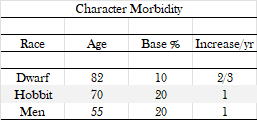
Starting at age 55, Men have a 20% chance to die of old age the following winter. That chance goes up 1% every subsequent year. 

Dwarfs start getting old at 82. At that age, they have a 10% chance to die the following winter, which increases by 2 every third year. 

Elfs do not have natural morbidity. 

Starting at age 70, Hobbits have a 20% chance to die the following winter. That chance goes up 1% every subsequent year. 

A character who is slated to die will die d% days after November 30. 

24 December 2022

Bullpen Chargen

No, not that bullpen. But close.

I think what I'm going to do is have each player roll up four sets of stats and a job and then have them assign a character class to each one. One limit is that only one of the four can be a demi-man. I'll call this the "Bullpen" and each player will have one. 

He will then choose one of the four and flesh it out into a whole character, and that will be his PC. When that PC dies (as they do) or needs a rest or retires, then they will go to their bullpen to flesh out the next guy. 

Let me show you the bullpen sheet. It will get better, but this one is functional:


Note the "Job" box. I made a list of bad medieval jobs (and some good ones too) and put them on a table. This is where the character came from before he was an adventurer. About 70% of all PCs will be farmers. A very few will have a useful background skill. If they get one, that's great, they can use it. 

Here are the Jobs tables:


This sheet is completely unfinished. I don't know what I will do to make it more attractive. I'm only showing it so you can see what jobs there are. 

Go ahead, ask me what a penfolder does. I dare you.


20 December 2022

Don’t Invest in Your Character?

Yes you read that right. Don’t invest in your character. 


What does that mean? It simply means that you can enjoy playing just as much - or even more - if you don’t consider your own character to be the center of your game experience. Here, I’ll explain why and then I’ll give you some suggestions how. 


OSR, or folkstyle d&d, is about problem-solving, not narrative. The primary problem is something like: “there’s treasure underground and monsters and traps protect it. How are we gonna get it out?” This leads to numerous other fun problems that we call “the campaign.” In the campaign, there is narrative - but it comes from solving problems, not from acting in the story the Ref has scripted for you ahead of time. 


This implies that your own brain is your primary tool for success. And that your character - sometimes I’ll call it your figure - is how your brain manipulates the game world. Again, your character is your tool, much like a chess man is a tool for solving the problems your opponent presents to you in a chess match. 


Now, nobody invests too much emotion in a pawn or a knight in chess. And I’m not suggesting you should be so cavalier about your character in d&d. But there is a happy medium there where you feel comfortable risking the figure’s death without breaking down in tears if he meets his fitting end. 


There’s another force at work against investing in your figure, and that’s time. The old games kept strict time, sometimes on a 1 day = 1 day basis. Whether your Ref plays like that or time is less iron-bound to real time, characters each need to spend time training to gain their next level, to heal injuries, to make magic items or supervise their castle’s construction, or just to learn spells. 


You see, healing magic only works while on adventures. God doesn’t grant you miracles for any old reason. You have to heal up in the normal fashion once you head back to town. 


Similarly, in folkstyle D, it takes time to learn spells: a full night’s rest and then 15 minutes of preparation for each spell level. Easy at your first few levels, but to reload a master wizard, it will take a day or so of study. A spell scroll takes a week to write; a potion, a whole day. A permanent magic item can take weeks. 


Characters also have lives away from the dungeon. Much of a character’s might is derived from land, alliances and favors owed. Gaining these takes time in town or at Court. A boy character may take a mistress or wife; that wife may bear him a child. This may suggest new adventures or alliances. A girl character might have a baby. This will keep her out of the dungeon for 12 months or more. 


At my table, and yours may vary, adventurers are only free to delve for about 18 weeks a year. They are required to serve in their Lord’s wars, they must do labor, politics or religious service, and the weather is just too frightful to expedite for many winter months. 


All these time squeezes mean that “Your Character” might not be ready to delve when the time comes for it. 


So what do we do when “Your Character” is tied up? Run a different figure of course. 


In the old days, men would run three, four, five different figures. Not all at once (but sometimes two at a time.) If the wizard died? Oh well, he’s dead, let’s get on with the fighting-man. 


I’m toying with the idea of a chargen minigame that pops out seven characters all at once. Not sure what I will call the system, but I will share it when I have it set. Doing seven at once ensures your backup guys are ready to go when needed.