Showing posts with label classes. Show all posts

16 March 2023

The Elf Issue

 When I first learned about the multiclassing rules for elf and half-elf fighter/mages, I was really bummed out. Not only do they take a significant cut in their number of hit points (half d10 and half d4,) but they can’t wear armor when they cast spells. 


Lol what? 


What kind of a fighter can’t wear armor?!


I imagined that the elf would have his magic plate mail in his backpack. Once he blew through his offensive spells, he would cast his defensive magic, put on his armor, and pick up a sword. 


This seemed stupid to me, especially with fewer hit points. 


I never played one. I did have one half-elf fighter/mage/thief but that was a short-lived experiment for some reason. 


I much preferred the Arensonian Elf class, where the elf was a fighter all the time and a wizard all the time. I got that. Even though they need hilariously high XP to level 2 (and then trail by at least one,) the idea of a sword and armor AND spells made sense. 


This clearly illustrates my fighter-bias, and even my specific melee-bias. Yes, I’m well biased towards melee types. Crown & Valor makes an effort to swing the power balance back in favor of melee toons. 


Later on, I realized the world building implications of the elf casting without armor; the cold-iron-and-faerie-dust aspect of it all, and so now, I can appreciate that for what it is and what it says about that multiverse. 


I might even try one the next time there’s a 1e game to be had. 

05 March 2023

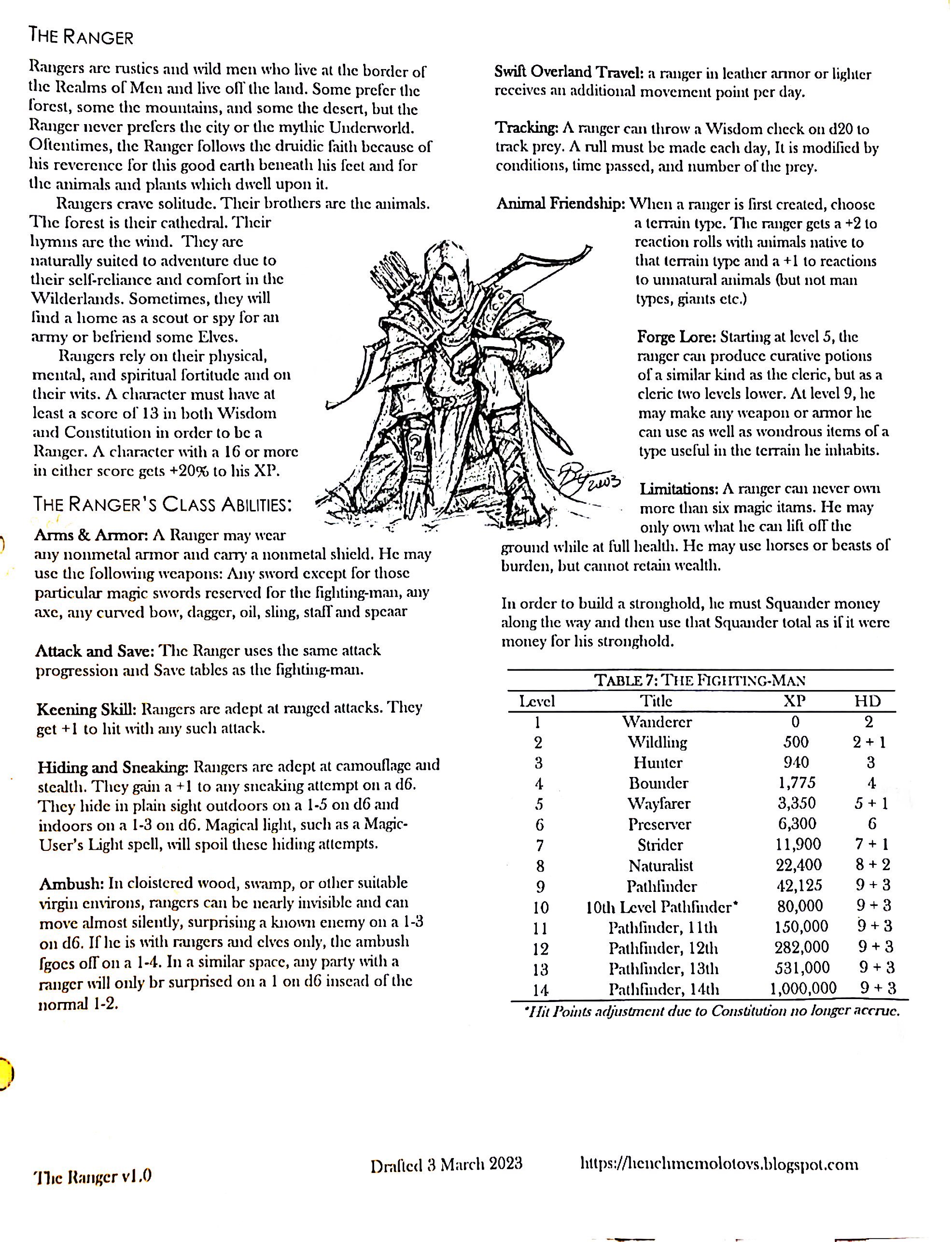
OSR Ranger for Crown & Valor

The OSR Ranger is not Aragorn, but neither is he not-Aragorn. I picture him more like an 18th and 19th (and 20th) century mountain man on the American frontier: self-sufficient and beset by wanderlust. 


The chassis of the class is the Hobbit class. You can see it with the hide and sneak abilities and with the ranged attack bonus. 


As a nod to the 1e Ranger, this ranger gets two hit dice at level 1. He then matches the fighting-man into Name levels, and caps out on hit dice a little sooner. 


On that I added the animal empathy and some ad hoc magic. I’m really not sure about the magic, and I’m not sure if I will ever have enough playtest experience to know whether it’s good, too strong, too weak, or off brand. Share your opinions and suggestions in the comments or via email. 


Here’s the .doc file


The Ranger


Rangers are rustics and wild men who live at the border of the Realms of Men. They are self-sufficient, and live off the fat of the land. Some prefer the forest, some the mountains, and some the desert, but the Ranger never prefers the city or the mythic Underworld. 


Oftentimes, the Ranger follows the druidic faith because of his reverence for this good earth beneath his feet and for the animals and plants which dwell upon it. 


Rangers crave solitude. Their brothers are the animals. The forest is their cathedral. Their hymns are the wind.  They are naturally suited to adventure due to their self-reliance and comfort in the Wilderlands. Sometimes, they will find a home as a scout or spy for an army or befriend some Elves.


Rangers rely on their physical, mental, and spiritual fortitude and on their wits. A character must have at least a score of 13 in both Wisdom and Constitution in order to be a Ranger. A character with a 16 or more in either score gets +20% to his XP. 


The Ranger’s Class Abilities: 


Arms & Armor: A Ranger may wear any nonmetal armor and carry a nonmetal shield. He may use the following weapons: Any sword except for those particular magic swords reserved for the fighting-man, any axe, any curved bow, dagger, oil, sling, staff and spear.


Attack and Save: The Ranger uses the same attack progression and Save tables as the fighting-man.


Keening Skill: Rangers are adept at ranged attacks. They get +1 to hit with any such attack. 


Hiding and Sneaking: Rangers are adept at camouflage and stealth. They gain a +1 to any sneaking attempt on a d6. They hide in plain sight outdoors on a 1-5 on d6 and indoors on a 1-3 on d6. Magical light, such as a Magic-User’s Light spell, will spoil these hiding attempts.


Ambush: In cloistered wood, swamp, or other suitable virgin environs, rangers can be nearly invisible and can move almost silently, surprising a known enemy on a 1-3 on d6. If he is with rangers and elves only, the ambush fgoes off on a 1-4. In a similar space, any party with a ranger will only br surprised on a 1 on d6 insead of the normal 1-2.


Swift Overland Travel: a ranger in leather armor or lighter  receives an additional movement point per day. 


Tracking: A ranger can throw a Wisdom check on d20 to track prey. A rull must be made each day, It is modified by conditions, time passed, and number of the prey.


Animal Friendship: When a ranger is first created, choose a terrain type. The ranger gets a +2 to reaction rolls with animals native to that terrain type and a +1 to reactions to unnatural animals (but not man types, giants etc.)


Forge Lore: Starting at level 5, the ranger can produce curative potions of a similar kind as the cleric, but as a cleric two levels lower. At level 9, he may make any weapon or armor he can use as well as wondrous items of a type useful in the terrain he inhabits. 


Limitations: A ranger can never own more than six magic itams. He may only own what he can lift off the ground while at full health. He may use horses or beasts of burden, but cannot retain wealth. 


In order to build a stronghold, he must Squander money along the way and then use that Squander total as if it were money for his stronghold. 


19 February 2023

Holmes-Style Monk

Father Dave over on Blood of Prokopius suggested a monk, in the Medieval sense, built on the Holmes cleric. I made several attempts, and made three or four different classes with different skin and different miracle/spell lists. Here is the Monk version for your edification and enjoyment. 


Here is the .doc file.


The Monk


A Monk (or Nun)  is a holy warrior who uses his faith in God to explore the realm and to make it safe and sound for Men and their allies. Furthermore, since he owes his strength to a higher power of some kind, he must act within the Lawful alignment, or be sanctioned in some way by that higher power. This means he must work on behalf of Mankind and it’s allies whenever appropriate. On the other hand, his faith in God protects him from attacks, lowering his Armor Class while unarmored and he performs special, powerful miracles called Wonders.

These are not always priests, but rather special individuals from inside and outside the Church who receive and answer, a special calling from God. A monk is infused with God’s power in order to undertake great and necessary tasks here in the mortal realm such bringing succor to remote communities, solving mysteries, questing for holy relics, and assisting pilgrims.

The Prime Requisite of the Monk is Wisdom. He uses the Cleric’s Attack and Saving Throw charts.

Arms & Armor: The Monk may use Leather armor and carry a shield, but doing so negates his natural Armor Class bonus. He may wear a helm without penalty. He may use the following weapons: Quarterstaff, Footman’s Flail, Club and Sling.

Magic Items: The Monk may use any magic items available to the Cleric, so long as they are not kinds of magical weapons or armor they are forbidden to use. He may read and write Cleric scrolls.

The Monk’s Class Abilities:

Wonder Working: Monks have the powerful ability to perform special actions called  Wonders. As the Monk gains experience levels, he will be able to perform more kinds of Wonders.

Wonders have effects that are identical to spells cast by Clerics or Magic-Users and Elves, but they are not spells.  Rather, they are extraordinary abilities. Anti-magic and Dispel Magic do not work against these Wonders, and they cannot be disrupted by hit point damage like a spell can when it is being cast. The working of Wonders is more akin to the ability to Turn Undead. Use the appropriate spell descriptions to adjudicate these Wonders.

In order to work a Wonder, the Monk rolls 2d6. The Wonder works if this number meets or exceeds the target number for the Wonder in question (see Table 2.) More powerful Wonders are available at higher experience levels, and the ones granted become easier to use.

The Monk may attempt to work a Wonder once per Turn (10 minutes.) He may use each Wonder once per day. If the Monk attempts to work a Wonder and is unsuccessful, he may attempt to work the same Wonder later in the same day until it is successful.

Monks require some object of religious significance like a mirror, a cross or other holy symbol to use their Wonder ability; but the power to it is invested in he himself and not the object.

Uncanny Hand: A Monk may substitute his Wisdom score for his Dexterity score at any time.


Smite: Using an allowed weapon, the Monk may attempt to Smite. This special attack must be declared prior to rolling the attack roll. This attack gains a +4 to hit that stacks with any other bonuses and deals double damage if it hits. He may attempt this once per day at first level, twice per day at third level, and three times per day at fifth level and higher.


Armor of God: A Monk is a special creature, watched over by God. He has a naturally better Armor Class than other characters and that Armor Class gets better as he gains experience levels. However, if he wears armor or uses a shield, that bonus goes away.


Monster Hunting: Upon encountering a kind of monster for the first time, the Monk may make an Intelligence check on 1d20 to see if he has learned something about it in his catechism or travels.


Read Languages: The Monk has a 10% chance per experience level to read any non-magical writing. At level 8, he gains the ability to use arcane and divine scrolls.


17 February 2023

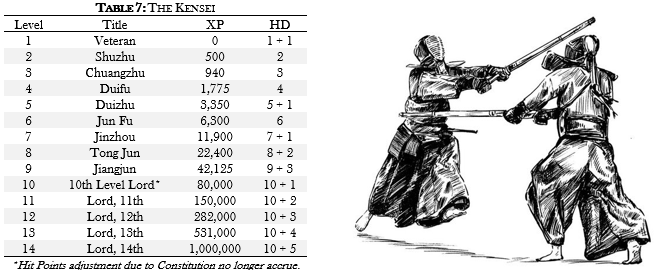
OSR Kensei Class

Cyfandil has an Asian-heritage region. If the several players want to visit, I think there ought to be some differences besides architecture. In addition to some different monsters (mostly ghosts and demons) and magic items, I'll construct at least a couple of classes that characters can encounter or even choose for themselves. I based the Kensei class on the Fighting-Man class. I think it's probably slightly weaker overall because kensei cannot take advantage of armor, shields and helms; they also do not have the inherent unit leadership structure advantages of the fighting-man, but they do retain the bonuses to attract and retain Retainers. 

A couple of their abilities begin at level 2 instead of 4 for the fighter: demon sense (a replacement for sense invisible) and great bravery. Potentially, great bravery will be very useful at the lower levels. 


The Kensei 


The Kensei is an unarmored warrior from Sho lands. He is excellent with one- or two-handed weapons but does not use any armor. Instead, he trains in techniques which make him naturally harder to hit.
          When a Fighting-Man reaches at least second level, he may convert his Fighting-Man levels to Kensei levels, and foreverafter progress in the Kensei class.
          However, the Kensei candidate must have both a Wisdom and Dexterity of 14 or better in order to assume the class. Additionally, he must know the Ponta language, which is the common tongue of the lands of the Sho people.
          The Prime Requisites of the kensi class are Wisdom and Dexterity. A Kensei with a Wisdom and Dexterity of 14 or more gains a +20% adjustment to all earned XP.

The Kensei’s Class Abilities:

Arms & Armor: The Kensei uses no armor nor shield. He may use any weapon including the most powerful magic swords.
 
Unarmored Fighting: When wearing no armor, the Kensei enjoys a bonus to his armor class equal to (WIS – 10) or (DEX – 10,) whichever is better.
 
Weapon Specialization: The Kensei always gets +1 to his damage roll when he hits his opponent. This is in addition to any bonus due from other sources.
 
Mantle of Leadership: A Kensei may have one more Retainer than his CHA would normally indicate. Any henchmen he leads get a +1 on their Morale checks.
 
Cleave: When in melee with people or creatures with fewer Hit Dice than himself, the Kensei may make one attack against each adjacent figure rather than a single attack against a single figure. However, this attack is resolved on the Fighting-Man 1-3 line of the attack matrix (rather than his normal line, if different.) Opponents of 4 Hit Dice or more are immune to this special attack.
 
Critical Hit: If a Kensei attacks a foe with an attack which is able to damage the target, and the player rolls a natural 20 (before any adjustments), the target is brought immediately to 0 Hit Points. He may damage creatures that have magical immunities using normal weapons.
 
Demon Sense: The Kensei may sense unseen demons and undead. This ability works out to 30’ (3 scale inches indoors and 1 scale inch outdoors.)
 
Great Bravery: Kensei are immune to fear, including magical fear.
          In addition, strarting at Level 4, they force an immediate Morale check by their opponents when they cross within melee range (3 scale inches) with 1 HD normal-types.
 
Forge Lore: At level 9 and above, Kensei may craft weapons in their strongholds using the same rules as Magic-Users do. They may not craft other kinds of magic items.


10 February 2023

Revised Fighting-Man Level Titles

The “boring old fighter” trope has always bothered me. It’s also spawned many combat classes with different wrinkles, as if being the best at fighting in a game that features good fighting isn’t enough. 


Awesome like this. 

I have given a lot of thought on how to — not necessarily improve the fighting-man class, but to change a player’s eye level when he looks at the class. 


I’ve decided to restrict commanding military operations to the fighting-man. The higher the level, the more troops he can command on a battlefield. I did the math and I think a 10th level Lord can command almost 27,000 men; a few directly, but most through a solid chain of command structure. 


This is why every evil wizard has a fighter in tow. This is why kings are kings: they have the loyalty of great fighting-men. 


Therefore there is a lot of implied setting here. Fighting-men are not just better at this particular thing; being a fighting-man affords political power and respect that a plain old +1 arming sword cannot. 


And from there, it is obvious I should change the level titles. Here they are:


Alt. Fighter ranks 


Veteran 1st

Sergeant 2nd

Lieutenant 3rd

  • can lead 10x level men 

Captain or Hero 4th

Centurion 5th

Tribune 6th

Legate 7th

Prefect 8th

  • can lead 20x level men and additionally 2 of the next lowest rank 

Lord 9th

30 January 2023

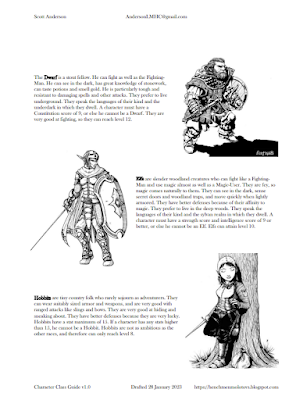
Cyfandil Starting Classes

This is the quick start page I'm going to hand out when we are ready to roll up our first characters. These are the big six (with a hidden seventh) but there are other classes which I will reveal in time. 


Here is the text: 

Quick Start Class Guide
 

You can get a copy of the PDF here.