
These are cheap ways to give the players a feeling of being in a magical realm, and may function as a silver bullet in their time of need.
Also remind them that giving gifts to your followers will encourage loyalty.
When I first learned about the multiclassing rules for elf and half-elf fighter/mages, I was really bummed out. Not only do they take a significant cut in their number of hit points (half d10 and half d4,) but they can’t wear armor when they cast spells.
Lol what?
What kind of a fighter can’t wear armor?!
I imagined that the elf would have his magic plate mail in his backpack. Once he blew through his offensive spells, he would cast his defensive magic, put on his armor, and pick up a sword.
This seemed stupid to me, especially with fewer hit points.
I never played one. I did have one half-elf fighter/mage/thief but that was a short-lived experiment for some reason.
I much preferred the Arensonian Elf class, where the elf was a fighter all the time and a wizard all the time. I got that. Even though they need hilariously high XP to level 2 (and then trail by at least one,) the idea of a sword and armor AND spells made sense.
 |
This clearly illustrates my fighter-bias, and even my specific melee-bias. Yes, I’m well biased towards melee types. Crown & Valor makes an effort to swing the power balance back in favor of melee toons.
Later on, I realized the world building implications of the elf casting without armor; the cold-iron-and-faerie-dust aspect of it all, and so now, I can appreciate that for what it is and what it says about that multiverse.
I might even try one the next time there’s a 1e game to be had.
|
Hollow Weapons
Hollow weapons are special weapons
which ignore magical wards and banes. Missile weapons impart the hollow quality
to their ammunition. There are three known keyworded types.
· Lifehollow weapons ignore
magic spells as well as inborn properties which require a weapon to be magic in
order to damage the target.
· Banehollow weapons ignore
magical plusses from armor and similar artificial defenses.
· Truehollow weapons ignore
both types of protection.
Hollow weapons are partially
translucent, appearing as if made from smoked glass instead of their normal
material. No hollow weapon may have any magic spell cast on it, nor can it have
a magical plus to hit or damage. If a character wields such a weapon it is
impossible to hide in the dark because it emits a dim pink and blue nimbus at
all times, clearly visible in the dark.
Chorizite
Hollow weapons take advantage of the
antimagic properties of the mineral Chorizite. Chorizite ore is quite valuable,
trading at 100:1 with gold by weight (1,000 GP per pound.)
An alchemist, hedge wizard, magic-user
or elf can imbue a potion with the pink, chalky ore and then a blacksmith or
weaponsmith can imbue a weapon with hollow qualities. One weapon can be so
imbued with 10cn worth of Chorizite valued at 1,000 GP plus 50 GP for the
alchemist’s labor and expertise. Each time a weapon is imbued it will gain one
property, based on the kind of Chorizite potion the alchemist makes.
Each Chorizite potion takes
one day and 50 GP in materials; a finished potion sells for 1,100 GP.
A blacksmith takes one day to imbue a
weapon with the potion at a cost of 100 GP.
The entire process takes locating some
Chorizite, two days, and 1,200.
Other uses for Chorizite
Chorizite potions can be used to
attempt to strip the magic from a magic item. This takes one hour and can be
performed by anyone.
Chorizite can be applied to other
permanent items such as shields, armor, equipment, etc.; this makes the items
immune from enchantments of any kind, including magical enhancement.
Can chorizite be applied to a container
or even a room? Perhaps...
| ||
Bloodhunting Weapons
Bloodhunting weapons are infused with Bloodhunter
Oil. When a Bloodhunter weapon hits and damage is rolled, reroll all
die rolls of 1 or less.
Making Bloodhunter Oil
This special infusion is made from the
bodies of magical predators such as Bulettes or Hell Hounds, or the bodies of
demons, and is therefore both rare and expensive. An alchemist, Hedge Wizard,
Elf or Magic-User can make up to six doses at a time, which takes a week. One
application of Bloodhunter Oil costs 2,000 GP. An alchemist can make it from
seven pounds of appropriate flesh. This oil can be applied by a blacksmith or
weaponsmith. A bow so enchanted confers this property to its arrows but a sling
cannot be so enchanted.
Creatures without blood or some analog
are not affected by this quality. Thing such as golems, zombies and gargoyles,
for instance, are immune.
Bloodhunter Oil can be applied to
hollow weapons and vice-versa.
Do dwarves and hobbits have wizards of their races? The answer is yes. Dwarfs especially use magic for knowledge and defense. However, there are two reasons why we do not see the magic-users of these races. One is that it takes a large investment to raise up a wizard. The practitioner is simply too valuable to allow such agency and the wizard has great responsibility to his fellows. The other is that adventuring is a fundamentally human pursuit. The other races do not do it much, and those who do tend to be the black sheep of their communities. Therefore, is very rare indeed for outsiders to meet or recognize wizards among the shorter kinds.

On the topic of Clerics, demikind come to religion in their own ways, but each can indeed call upon the power of God for great miracles. And again, you will likely never see such a demi -man, for they who do such don’t do adventuring.

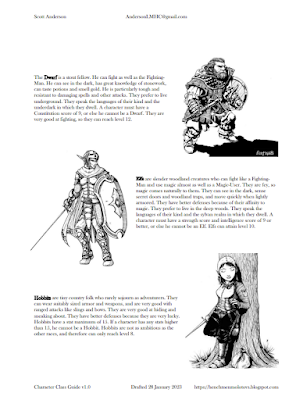

There are three other regular classes and three minor classes (lower power level) but these are the ones I want to make available at the start of the campaign.
As follows:
When you devise your character, one important choice to make is his character class. Character class will determine what special abilities you may use to interact with the environment, such as casting magic spells or becoming a master swordsman.
There are six classes to choose from. Three are human professions, and three are the demi-human races of Dwarf, Elf and Hobbit.
Humans hear a faint noise on a 1 on 1d6 and have no other special detection abilities. However, they have no restrictions based on race, and they can reach level 14 in any of their classes. Here are the three human classes:
Clerics are holy warriors. Clerics use any armor and shield, and can use any blunt weapon. They are always Lawful. They can turn (scare away) undead, they know special secrets about how to fight horrible monsters, they perform miracles, and they can write scrolls. They have the most favorable XP chart of all classes.
Fighting-Men are great leaders. They can use any weapon or shield, and any weapon including special magic swords. They get special combat advantages, special social interaction advantages, and have the most prestige among the realms of men.
Magic-Users (or Wizards) use the most powerful kind of magic: arcane spells. They create magic items of every kind. They are the nuclear weapons of the fantasy medieval world, but start out somewhat weak.
Dwarfs are stout. A character must have a Constitution of 9 or better or else he cannot be a Dwarf. They can use any armor and shield, and any short weapon. They can carry extra loot, but move slow. They can see in the dark, can smell gold, can test potions by taste, are experts at stonework, and have exceptionally good saving throws. They speak some extra languages of their kind. Dwarfs can attain level 12.

Elfs are fey. A character must have a Strength and Intelligence of 9 or better or else he cannot be an Elf. They can use any armor and shield and use almost every weapon, as well as using arcane magic. Lightly-encumbered elfs move faster than any other character. They can see in the dark, and have special senses for the wilderlands and regarding secret doors. They speak some extra languages of their kind. Elfs can reach level 10.
Hobbits are tiny country folk. If a character has any primary stat higher than 15, they cannot be a hobbit. Hobbits can wear any armor and carry a shield, but it must be properly sized. They can use any small weapon. Hobbits are very good at hiding and sneaking, and have exceptional aim. Hobbits can attain level 8.
We covered the game-mechanical process of collecting new spells in a prior post, but today we will discuss the in-game process of getting new spells and the worldbuilding implications of same.

We begin by saying that there are only 78 spells: 13 per level times six spell levels.
A magic-user or elf will start the game having four spells in his spellbook. Two of them are standards that every arcanist must know: Read Magic and Detect Magic. Then we grant two first-level spells: one chosen, and the other assigned at random from the remaining ten. How do arcane casters gain more?
The answer is, they must find them as treasure, capture them from a worthy foe, or negotiate for them with other magic-using types.
A human or elf spellcaster will never give a spell away. They are the nuclear weapons of D&D, far too valuable to give away gratis. Nor is it likely that a dweomerist will trade a spell, level for level.
An elf or human wizard who is particularly hard up may sell the knowledge of a spell to a trusted colleague, but never for less than 1,000 GP per spell level, and probably not at all. Usually double this, some some significant magic item, or a quest.
Henchmen, retainer and hireling NPCs may not want to deal with this at all, and then only with a significant bonus. They will outright refuse PCs who are not their master.
More likely than this, a wizard or dragon may bestow the new spell upon a PC in exchange for exceptional service or the gift of a magic item.
A sure, albeit expensive way to gain spells is through spell research. In this world, the wizard must have access to a laboratory and library worth no less than 1,000 GP per spell level researched: 1,000 GP for first, 2,000 GP for second, etc. This redoubt takes a month per spell level to construct and can be expanded as needed, provided there is room (but cannot be moved.) Then the wizard must spend 1,000 GP and one week per spell level researched. At the end of the week, the player makes an INT roll to see if the spell is successfully researched.
Another benefit of the lab is that the player, along with the Referee, may think up a spell not in the list of 78 for that wizard to acquire.
The most common way to gain new spells, though, is to discover them in old books and scrolls sconced in treasure hoards. By means of Read Magic and a little luck (INT roll,) the endwimmerist in question can add any of the spells to his book. This will destroy a scroll but will not damage a spellbook.
It takes one day per spell level to copy the spell, and any level spell can be copied even if it is beyond the mentalist’s casting ability at that time. The wizard cannot simply cast the spell from the book, however, because each wizard uses his own cypher to record such secret knowledge.
These processes suggest certain elements of the setting. Spells are rare and very valuable. There are only a few true wizards, and many will know other wizards by reputation. There used to be more wizards, as evidenced by the many scrolls and books left in hoards. Collecting spells is one way for the wizard to remember his adventures and journeys, for each one will come to him through some unique interaction with the game world.
On Dwarf and Hobbit arcanists
Do dwarves and hobbits have wizards of their races? The answer is yes. Dwarfs especially use magic for knowledge and defense. However, there are two reasons why we do not see the magic-users of these races. One is that it takes a large investment to raise up a wizard. The practitioner is simply too valuable to allow such agency and the wizard has great responsibility to his fellows. The other is that adventuring is a fundamentally human pursuit. The other races do not do it much, and those who do tend to be the black sheep of their communities. Therefore, is very rare indeed for outsiders to meet or recognize wizards among the shorter kinds.

This is how.
Henchmen, Hirelings, Specialists and Retainers
We toss these words around as if they are interchangeable, but they’re not.
Henchmen and hirelings are indeed interchangeable - they are the NPCs who work for pay and fight on the PC’s behalf.
Specialists are those with skills other than fighting and dying; anyone from a seamstress to a swordsmith to a solicitor.
None of these types ever gains XP, even if they have a class and level.
Retainers come in three flavors: special trusted assistants to the PC with class and level who take up a Retainer slot, charmed creatures (who also take up Retainer slots) and special animal companions such as a Paladin’s war horse or wizard’s familiar.
Retainers must be of a lower experience level or hit die than the character himself. Indeed, why would an NPC pledge his service to a lord who is as inexperienced as himself? The purpose of becoming a retainer, or follower, is to gain protection, knowledge, and reputation from the greater lord.
On retainers’ experience levels
No matter what level the PC is, the vast majority of those who will offer service will be of first level. PCs of level 4 or higher will attract 2nd or 3rd level retainers 20% of the time. (81-90 2nd, 91-00 3rd.)
PCs of level 8 or higher will attract followers up to 6th level. (61-70 2nd level, 71-80 3rd level, 81-90 4th level, 91-97 5th level, 98-00 6th level.)
If a PC has at least one henchman of level 1 or better, and they have henched for the PC for at least one season, one henchman of the Referee’s choice may ask to become a retainer. At which point the PC may accept, converting that paid hireling into a trusted Retainer, or the PC may decline. If he declines, the henchman will make a morale check. If failed, he will leave the PC’s company immediately in shame, anger or disgust.
Exceptions
PCs with their maximum retinue will not receive such offers of servitude.
Dwarfs will not pledge service to elves or hobbits. Elves will not pledge service to dwarfs or hobbits. Men may pledge service to hobbits but it is unusual to see. Of course each race strongly favors its own as master.
A magic-user will not pledge his service to a cleric.
A cleric will not pledge his service to anyone except a cleric or a lawful fighting-man, dwarf or hobbit.
An anticleric may pledge service to anyone, but it is usually for ulterior motives.
Another exception is in the case of a wizard with Charmed minions. A low-level wizard may be able to collect a minion of greater level, such as a first-level wizard with an ogre in a retainer slot
Henchmen gaining levels
A Retainer levels up normally just like any character. In the unlikely event one attains the same level as his master, he will then immediately leave to seek his own fortune, perhaps and a friend and perhaps not.
Let’s talk about how I do magic in my game. It’s almost straight up the same as the folkstyle D&D you are familiar with. But there are some small differences, small wrinkles, which will make some large difference.
Initially, a lot of the details I share here will seem like surface fluff. They are important because each detail augers into the game world. That which is window dressing in a board or video game is available here in TTRPGs to be manipulated and leveraged by clever players and NPCs. So pay attention.
Ready?

Arcane Magic:
Elfs and Men who are Magic-Users do the same kind of magic. We call it arcane magic.
Through ritual and study, they learn to call dweomers, which are a kind of vorpal being from a dimension orthogonal to our own. Once it is called, a dweomer dwells within its master’s neural pathways, much as a worm might dwell within an apple for a time. While it does, it shall vibrate at a neural frequency unique to its kind. This vibration is unpleasant for the master and requires long discipline to endure. No wonder then that a starting magic-user can only hold one in his head at a time, and only a meager one at that.
As a wizard gains experience, he will be able to contain greater and more numerous dweomers, each of which vibrates at different native frequency.
When its master chooses, he will command the dweomer to depart using specific gestures, the utterance of the dweomer’s True Name, and in some cases, a material focus designed to coax it. When it departs to its own realm, it creates a substantial effect in ours. In the layman’s vulgar tongue, this is called casting a spell.
If a caster (of any type) takes even a single hit point of damage while casting out his spell, the spell will be ruined and dissipate without effect. Merely jostling or attempting to distract the caster will not spoil the spell.
On coaxing and banishing dweomers:
In the morning or after a long rest, the arcane caster studies his spell book. It is the process of studying, and not any native knowledge the caster possesses, that makes it possible to call the proper dweomer. Therefore the spellbook is the caster’s prime possession.
To cast a spell, the arcane caster must be able to speak clearly and have at least one hand free to gesture. In the case of spells that have material components, be must be able to reach them.
A Man may not wear any kind of armor or bear a shield while he casts a spell (but can do so at other times,) for armor interferes with the movements necessary to call his spells. An Elf does not suffer this disability and may cast while holding one item as well as while wearing armor.

Men who fight in the Elven Manner are called Foresters:
Can a Man learn to cast as an Elf does? He can. He must choose this path at character creation. He will get a bonus starting language, Elven, and he will be presumed to be from quite nearby Elven lands. The man is able to cast like an elf does and fight like a man does. He will benefit from the Elf saving throw progression and also the Fighting-Man’s to hit rolls. However, the Man does not gain longevity, immunity from touch attacks, the Elf’s detection abilities, or darkvision. He also adopts the Elf’s unfavorable XP advancement chart and is level capped at 10. He does not gain the fighting-man’s class abilities.
Equipment:
The chief item necessary for spellcasting is the spellbook. A spellbook takes up one item slot. It contains exactly 39 pages. It can hold up to 13 inscribed spells. All spells so inscribed must be of the same spell level. Therefore if an arcane caster can use more than one spell level, he must carry a book for each level.

A spellbook costs 100 GP per spell level it holds. Therefore a level two spellbook costs 200 GP. No lesser expense will do. A new character’s first spellbook was given to him by his master during his training.
The arcane caster must also carry his spell’s material components and foci in a spell component container. This container takes up one additional item slot.
Learning new arcane spells:
Magic is weird and secret, and laymen consider it a tool of the Devil. Therefore wizards have to be very guarded about their spells. It is very unlikely that someone else will give you, or even sell you, a spell free and clear. There are always strings attached. And if another wizard learns that you’ve given away a spell at a price below normal, you may find yourself at the wrong end of a feeblemind spell.
So how do you learn more of them?
The first way is when you gain a level, you may add a spell from the conventional list to your spellbook of any level you can cast.
The next way is to attempt to transcribe a scroll spell into your spellbook. Doing so takes one week but no money. At the end of the week, make an INT check against 1d20. If you pass, you get the spell. If not, you can’t ever learn to call that dweomer (but can research something similar.)
The next way is to capture spellbooks. This also requires A week of study per spell and an INT check, just like a scroll, but the spell is not erased from the book.
The final common way to get new spells is to research them. It costs 100 GP per spell level and one week to research a new spell. This could be one on the conventional list or one you and your Referee make up together.
The research requires a permanent laboratory in which to host the books, components and experimental equipment. Wizards can share a laboratory. Each time you research a spell, you will collect some books and equipment too.
At the end of the week, make an INT check to see if you can learn this new spell. If not, you have to pay the time and money again.
Using and writing scrolls:

A spell scroll is a way to store a spell for later use. It binds a dweomer in a different way. An arcane caster first learns a spell, then transfers that spell knowledge onto a specially-cured paper using exotic inks. That spell is erased from his mind and encoded into the message in the paper.
It costs 100 GP per spell level to create such a scroll. So a third-level spell costs 300 GP to make. Regardless of the spell’s level, it takes one solid week of work to create it as well.
Only an arcane caster can use arcane scrolls. To do so, he only need read the words aloud. There are no gestures or components necessary, and the caster can do it as long as he can clearly see the words and diagrams of the spell, so within 1 scale inch in good light.
However, each scribe will use his own magical notation unique to his neural pathways. If a caster should discover a spell scroll from another hand, he must first cast Read Magic upon it to unlock its secrets for him.
When the scroll is used, the writing is consumed and evaporates. An empty scroll will disintegrate into ash.
Any number of spell scrolls up to 13 total spell levels will fit into a scroll case, a hard water-resistant tube meant for such things. Up to two scroll cases take up one item slot.
Potions:
A potion is a small drink that contains a magic spell or effect. Any character with normal-type internal organs can use a potion. Drinking a potion in combat is a miscellaneous action that takes effect at the end of the Round.

Potions are moderately breakable and your Ref may call for you to make a Save if you fall far, get burned, or have some other mishap - failure meaning a potion you are carrying is somehow spoilt. Up to four potions fit in an item slot.
Upon attaining 5th level, Spellcasters of both kinds can brew potions. Healing potions are especially popular. If you wish to brew a potion that doesn’t have an analogous spell, work with your Referee to come up with a way to make it. That might require research. It takes one day to brew a potion and costs 100 GP per spell level expenses in brewing it.
Permanent magic items:
Armor, cloaks, and especially swords, are some of the best kinds of treasures there are. Any class of character can create permanent magic items upon attaining 9th experience level, but only kinds of items that class can use. Creating a magic item takes a permanent laboratory and forge, and one week per “plus” or special ability it has. It also costs 2000 GP at minimum; depending on the item, it can be more valuable than the castle that houses it.

When a cleric makes an item, he can choose to Align it with a cosmic alignment matching his own - essentially making it a “holy” or “infernal” item. (Intelligent weapons always match the alignment of their maker.)
Clerical magic:

Not every priest or layman can call forth miracles from above. A man must be called by God into service, and then agree to serve God. A village priest or a devout soldier does not perform the miracles and wonders of the cleric. A true cleric can perform divine magic. These miracles are often called spells by laymen, just as arcane spells are.
Clerical magic only works when it is dramatically appropriate. A cleric can’t just go popping off spells to impress girls. He can’t even heal someone in town who has a good chance to recover; his magic is reserved for times when wonders and miracles are truly necessary.
In order to use this magic, the cleric must act within his alignment to the best of his ability. If he strays from God’s moral and civilization’s ethical code either on purpose or without contrition, he will not be able to use magic.
Rituals, Prayers and Commands:
In terms of game mechanics, there are three categories of clerical spells, called rituals, prayers, and commands.
A ritual takes ten uninterrupted minutes to set up and then it’s effects are permanent.
A prayer begins when the cleric casts the spell and then persists as long as the cleric continues to pray (to concentrate.) While maintaining the prayer he may take no other action except moving and turning undead.
A command begins when the cleric casts the spell and has a set duration. He need not take any other action to maintain the spell.
Equipment:
A cleric has a spellbook and components too, after a fashion. Every morning, the cleric must confess to God his sins and read the Scripture for a total of at least one hour. Then when he calls for God’s miracles, he must present his holy symbol: a cross or other holy device. This can be fashioned into a necklace or etched into a shield, among other display methods. His Bible takes up one item slot and his holy symbol none, but remember that clerics are almost always armored when on campaign.
A cleric knows how to ask for any spells he wants at the start of a day. God will grant them as asked under most circumstances.
A cleric can spontaneously cast his healing spells. (Or in the case of the anticleric, harming spells.) He chooses to “forget” one spell he has saved that day of the right spell level and then can perform the healing ritual in its place.
Divine scrolls:
Divine scrolls work like arcane scrolls except for a couple of small differences. First, divine scrolls are written in common and need no Read Magic. Second, the magic only works for the same people and under the same circumstances conventional divine magic functions. If a layman or enemy reads the scroll, or if a cleric reads one at the wrong time, nothing happens.
For those beings who are apprised of divine magic, if they attempt to use the scroll maliciously, they may be harmed in some way by God.


